Chemistry of urine : a practical guide to the analytical examination of diabetic albuminous, and gouty urine / Alfred H. Allen.
- Alfred Henry Allen
- Date:
- 1895
Licence: Public Domain Mark
Credit: Chemistry of urine : a practical guide to the analytical examination of diabetic albuminous, and gouty urine / Alfred H. Allen. Source: Wellcome Collection.
59/250 (page 41)
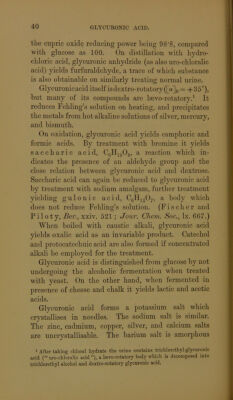
![and soluble in water. It is the compound employed for the isolation of glycuronic acid from urine. With phenyl-hydrazine, glycuronic acid forms a yellow crystalline compound melting at 114 to 115° C., but under modified conditions an amorphous, brownish-yellow body, melting at 150° C., is produced. According to J, A. H i r s c h 1, normal urine yields this compound (see page 88). For the actual isolation of glycuronic acid from urine a large quantity of the excretion is required. The method is described in an interesting report by H. H. Ashdown [Brit. Med. Jour., 1890, i. 169, and Pharin. Jour., [3], xx. 607). Glycuronic acid occurs in the urine to a very not- able extent after the administration of morphine, chloroform, chloral, butyl-chloral, nitrobenzene, cam- phor, curare, and certain other drugs. It was un- doubtedly mistaken for glucose by the older observers. In one case recorded by Ashdown large amounts of glycuronic acid occurred in the urine of a healthy young man, whose excretion was not abnormal either in volume or density. Glycosdric Acid is a body extracted by J. Marshall from pathological urine (^rcA Pliarm., [3], XXV. 593, and Jour. Chem. Soc., lii. 1047). It is isolated by a process based on the insolubility of the lead salt in alcohol of 45 per cent. Glycosuric acid crystallises in opaque tetragonal prisms, which melt at 140°, are readily soluble in water, alcohol, and ether, less readily in chloroform, and insoluble in benzene, toluene, and petroleum spirit. Glycosuric acid con- tains no nitrogen, is readily and completely absorbed by animal charcoal, and appears to be a phenolic de- rivative. It reduces Fehling’s solution more powerfully than glucose, and also reduces silver nitrate; but not bismuth compounds or alkaline solutions of picric acid.](https://iiif.wellcomecollection.org/image/b28138818_0059.jp2/full/800%2C/0/default.jpg)