Chemistry of urine : a practical guide to the analytical examination of diabetic albuminous, and gouty urine / Alfred H. Allen.
- Alfred Henry Allen
- Date:
- 1895
Licence: Public Domain Mark
Credit: Chemistry of urine : a practical guide to the analytical examination of diabetic albuminous, and gouty urine / Alfred H. Allen. Source: Wellcome Collection.
92/250 (page 74)
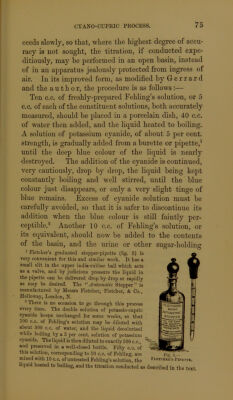
![7 4 gerrard’s process. open to grave objections, and he is unable to recom- mend it. Gerrard’s Cyano-cupric Process of Glucose- titration.—A volumetric method of sugar titration, which will probably supersede all the other forms of copper determination of diabetic glucose, has been de- vised by A. W. G e r r a r d. The process, as originally published {Year-Book Pharm., 1892, page 400, and Pharm. Jour., [3], xxiii. 208), did not yield good results, but the writer has obtained further parti- culars from the inventor of the process, and has person- ally investigated the sources of error and the pre- cise conditions necessary to ensure success. Gerrard’s process is based on the following facts :— When a solution of potassium cyanide is added to one of a cupric salt, a double cyanide of potassium and copper is formed, according to the following equation :—CUSO4 -f 4KCy = CuCy2,2KCy -f K2SO4. The double cyanide of potassium and copper thus formed is not decomposed by alkali nor precipitated by sulphuretted hydrogen. Its solution is colourless or faintly yellow. If Fehling’s solution be employed instead of one of cupric sulphate, the same colourless double cyanide is formed, and the solution gives no precipitate of cuprous oxide when boiled with glucose solution. If Fehling’s solution be present in quantity more than sufficient to react with the potassium cyanide used, this extra portion will suffer reduction by glucose; but instead of the cuprous oxide being precipitated it will remain in solution, and the pro- gress and end of the reduction will be indicated by the gradual lessening and ultimate entire disappearance of the blue colour. Hence in outward appearance the method resembles that of Pavy (see page 67), but it has the advantage of causing no evolution of ammonia. Further, the re-oxidation of the reduced solution pro-](https://iiif.wellcomecollection.org/image/b28138818_0092.jp2/full/800%2C/0/default.jpg)