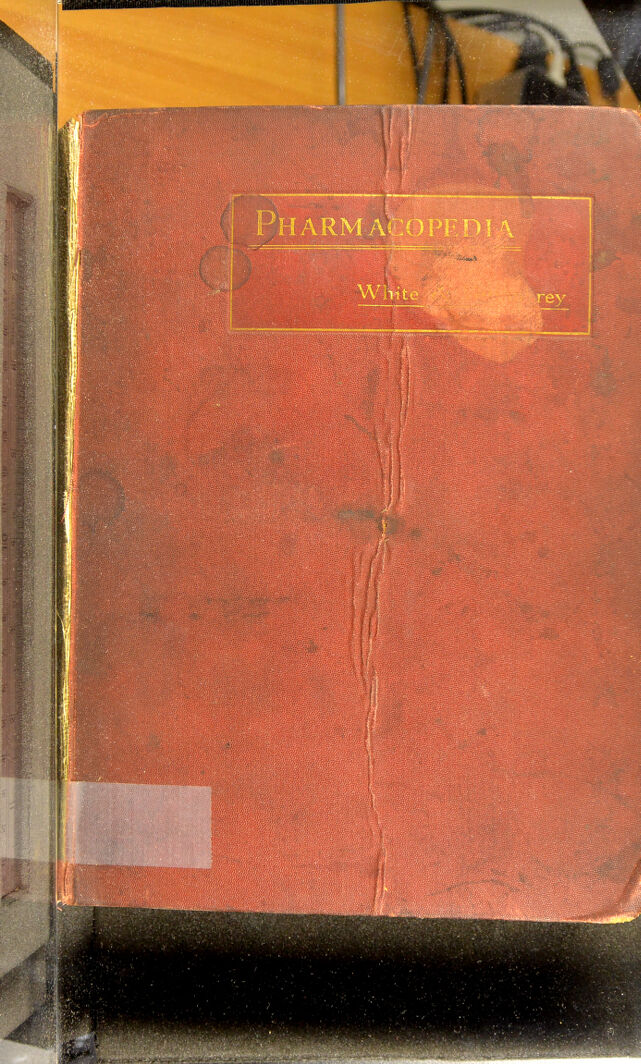
Pharmacopedia, a commentary on the British pharmacopoeia, 1898 / by Edmund White ... and John Humphrey.
- Edmund White
- Date:
- 1901
Licence: In copyright
Credit: Pharmacopedia, a commentary on the British pharmacopoeia, 1898 / by Edmund White ... and John Humphrey. Source: Wellcome Collection.
Provider: This material has been provided by King’s College London. The original may be consulted at King’s College London.
13/724 page 11
![with the proportions of active constituents in the preparations of potent drugs, since no one can be a safe dispenser without that ]<nowIedge. In the following pages, the details of the Pharmacopoeia have been dealt with in a manner which experience has proved to be the best tu follow in dealing with a work of such extended range. The articles mentioned in the Pharmacopceia are considered in alphabetical order, care being taken to expand and explain the statements in each monograph, whilst endeavours are also made to use such explanations as illustrations of the principles involved. It is hoped that students will thus be assisted in the acquirement of the habit of applying their knowledge, intelligently and usefully, to the elucidation of problems of allied nature. The explanations offered are very full in most cases, and students are advised not to rest content with anything less than the ability to explain every statement made in the Pharmacopoeia. In the case of the chemistry of that work, numerous instances occur in which the knowledge involved extends considerably beyond what is usually contained in the text-books used by pharmaceutical and medical students. Such information is here supplied, and the chemistry of drugs is also dealt with in a manner which, it is believed, will be found more satisfactory than is usually the case. Students are warned, however, not to rest content with knowing what are the chief constituents of drugs ; they should also learn as much as possible about their composition, properties, and analogies with similar substances found in the same or other drugs. On the botanical side, it is chiefly of importance to say that the exact significance of all technical terms employed in the Pharmacopoeia should be ascertained by reference to a suitable glossary. Crude vegetable drugs should be studied in a practical manner, each drug being carefully compared with its illustration in the ' Pharmacopedic Atlas,' and with the printed description, differences being noted when they exist, and explanations of those differences sought. A good plan for impressing upon the memory the chief features of crude drugs of vegetable origin is to make careful sketches of them, dried flowers and leaves being previously soaked in water to expand them, Transverse sections should also be prepared and sketched, on an enlarged scale if necessary. Further, it should be borne in mind that there is a very close connection between botany and pharmacognosy, and that careful study of the morphology and anatomy of vegetable drugs is required in order to obtam^ a thorough grasp of their structure. A pocket lens should be used freely m this connection, and a microscope whenever necessary. The pharmacy of the Pharmacopoeia is the subject of special treatment in the followmg pages. Students should deal practically with this subject also, endeavouring to make as many as possible of the official preparations, and paying particular attention to their general composition and physical properties, as well as to their behaviour with substances with which they are commonly prescribed. Extended knowledge in this direction cannot be obtained properly by mere reading; it can only be usefully and permanently acquired by practical work, btudents should acquire as much detailed information as they can in that](https://iiif.wellcomecollection.org/image/b21297216_0013.jp2/full/800%2C/0/default.jpg)