The foundations of The origin of species : a sketch written in 1842 / edited by Francis Darwin.
- Charles Darwin
- Date:
- 1909
Licence: Public Domain Mark
Credit: The foundations of The origin of species : a sketch written in 1842 / edited by Francis Darwin. Source: Wellcome Collection.
42/94 page 10
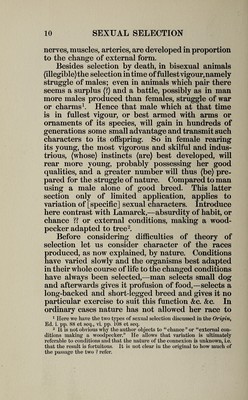
![nerves, muscles, arteries, are developed in proportion to the change of external form. Besides selection by death, in bisexual animals (illegible) the selection in time of fullestvigour,namely struggle of males; even in animals which pair there seems a surplus (?) and a battle, possibly as in man more males produced than females, struggle of war or charms1. Hence that male which at that time is in fullest vigour, or best armed with arms or ornaments of its species, will gain in hundreds of generations some small advantage and transmit such characters to its offspring. So in female rearing its young, the most vigorous and skilful and indus¬ trious, (whose) instincts (are) best developed, will rear more young, probably possessing her good qualities, and a greater number will thus (be) pre¬ pared for the struggle of nature. Compared to man using a male alone of good breed. This latter section only of limited application, applies to variation of [specific] sexual characters. Introduce here contrast with Lamarck,—absurdity of habit, or chance ?? or external conditions, making a wood¬ pecker adapted to tree2. Before considering difficulties of theory of selection let us consider character of the races produced, as now explained, by nature. Conditions have varied slowly and the organisms best adapted in their whole course of life to the changed conditions have always been selected,—man selects small dog and afterwards gives it profusion of food,—selects a long-backed and short-legged breed and gives it no particular exercise to suit this function &c. &c. In ordinary cases nature has not allowed her race to 1 Here we have the two types of sexual selection discussed in the Origin, Ed. i. pp. 88 et seq., vi. pp. 108 et seq. 2 It is not obvious why the author objects to “chance” or “external con¬ ditions making a woodpecker.” He allows that variation is ultimately referable to conditions and that the nature of the connexion is unknown, i.e. that the result is fortuitous. It is not clear in the original to how much of the passage the two ? refer.](https://iiif.wellcomecollection.org/image/b31351761_0044.jp2/full/800%2C/0/default.jpg)