The foundations of The origin of species : a sketch written in 1842 / edited by Francis Darwin.
- Charles Darwin
- Date:
- 1909
Licence: Public Domain Mark
Credit: The foundations of The origin of species : a sketch written in 1842 / edited by Francis Darwin. Source: Wellcome Collection.
85/94 page 51
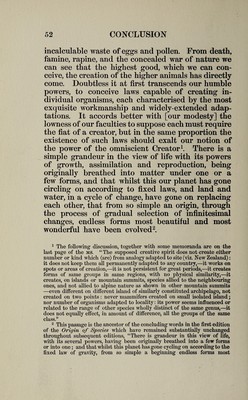
![feel far more interest in examining it. How in¬ teresting is every instinct, when we speculate on their origin as an hereditary or congenital habit or produced by the selection of individuals differing slightly from their parents. We must look at every complicated mechanism and instinct, as the sum¬ mary of a long history, (as the summing up) of1 useful contrivances, much like a work of art. How in¬ teresting does the distribution of all animals become, as throwing light on ancient geography. [We see some seas bridged over.] Geology loses in its glory from the imperfection of its archives2, but how does it gain in the immensity of the periods of its formations and of the gaps separating these formations. There is much grandeur in looking at the existing animals either as the lineal descendants of the forms buried under thousand feet of matter, or as the coheirs of some still more ancient ancestor. It accords with what we know of the law impressed on matter by the Creator, that the creation and extinction of forms, like the birth and death of individuals should be the effect of secondary [laws] means3. It is derogatory that the Creator of countless systems of worlds should have created each of the myriads of creeping parasites and [slimy] worms which have swarmed each day of life on land and water (on) [this] one globe. We cease being astonished, however much we may deplore, that a group of animals should have been directly created to lay their eggs in bowels and flesh of other,—that some organisms should delight in cruelty,—that animals should be led away by false instincts,—that annually there should be an 1 In the Origin, Ed. i. p. 486, vi. p. 665, the author speaks of the “ sum¬ ming up of many contrivances ”: I have therefore introduced the above words which make the passage clearer. In the Origin the comparison is with “a great mechanical invention,”—not with a work of art. 2 See a similar passage in the Origin, Ed. i. p. 487, vi. p. 667. 3 See the Origin, Ed. i. p. 488, vi. p. 668.](https://iiif.wellcomecollection.org/image/b31351761_0087.jp2/full/800%2C/0/default.jpg)