The foundations of The origin of species : a sketch written in 1842 / edited by Francis Darwin.
- Charles Darwin
- Date:
- 1909
Licence: Public Domain Mark
Credit: The foundations of The origin of species : a sketch written in 1842 / edited by Francis Darwin. Source: Wellcome Collection.
86/94 page 52
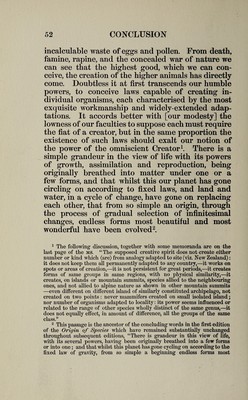
![incalculable waste of eggs and pollen. From death, famine, rapine, and the concealed war of nature we can see that the highest good, which we can con¬ ceive, the creation of the higher animals has directly come. Doubtless it at first transcends our humble powers, to conceive laws capable of creating in¬ dividual organisms, each characterised by the most exquisite workmanship and widely-extended adap¬ tations. It accords better with [our modesty] the lowness of our faculties to suppose each must require the fiat of a creator, but in the same proportion the existence of such laws should exalt our notion of the power of the omniscient Creator1. There is a simple grandeur in the view of life with its powers of growth, assimilation and reproduction, being originally breathed into matter under one or a few forms, and that whilst this our planet has gone circling on according to fixed laws, and land and water, in a cycle of change, have gone on replacing each other, that from so simple an origin, through the process of gradual selection of infinitesimal changes, endless forms most beautiful and most wonderful have been evolved2. 1 The following discussion, together with some memoranda are on the last page of the ms. “ The supposed creative spirit does not create either number or kind which (are) from analogy adapted to site (viz. New Zealand): it does not keep them all permanently adapted to any country,—it works on spots or areas of creation,—it is not persistent for great periods,—it creates forms of same groups in same regions, with no physical similarity,—it creates, on islands or mountain summits, species allied to the neighbouring ones, and not allied to alpine nature as shown in other mountain summits —even different on different island of similarly constituted archipelago, not created on two points : never mammifers created on small isolated island; nor number of organisms adapted to locality: its power seems influenced or related to the range of other species wholly distinct of the same genus,—it does not equally effect, in amount of difference, all the groups of the same class.” 2 This passage is the ancestor of the concluding words in the first edition of the Origin of Species which have remained substantially unchanged throughout subsequent editions, “There is grandeur in this view of life, with its several powers, having been originally breathed into a few forms or into one; and that whilst this planet has gone cycling on according to the fixed law of gravity, from so simple a beginning endless forms most](https://iiif.wellcomecollection.org/image/b31351761_0088.jp2/full/800%2C/0/default.jpg)