[Report 1936] / Medical Officer of Health, Oldham County Borough.
- Oldham (England). County Borough Council. nb2004302054.
- Date:
- 1936
Licence: Attribution 4.0 International (CC BY 4.0)
Credit: [Report 1936] / Medical Officer of Health, Oldham County Borough. Source: Wellcome Collection.
77/140 page 75
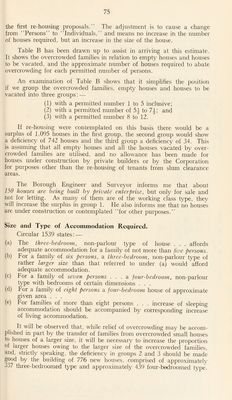
![the first re-housing proposals.” The adjustment is to cause a change from “Persons” to “Individuals,” and means no increase in the number of houses required, but an increase in the size of the house. Table B has been drawn up to assist in arriving at this estimate. It shows the overcrowded families in relation to empty houses and houses to be vacated, and the approximate number of houses required to abate overcrowding for each permitted number of persons. An examination of Table B shows that it simplifies the position if we group the overcrowded families, empty houses and houses to be vacated into three groups: — (1) with a permitted number 1 to 5 inclusive; (2) with a permitted number of 5.] to 7\', and (3) with a permitted number 8 to 12. If re-housing were contemplated on this basis there would be a surplus of 1,095 houses in the first group, the second group would show a deficiency of 742 houses and the third group a deficiency of 34. This is assuming that all empty houses and all the houses vacated by over¬ crowded families are utilised, and no allowance has been made for houses under construction by private builders or by the Corporation for purposes other than the re-housing of tenants from slum clearance areas. The Borough Engineer and Surveyor informs me that about 150 houses are being built by private enterprise, but only for sale and not for letting. As many of them are of the working class type, they will increase the surplus in group 1. He also informs me that no houses are under construction or contemplated “for other purposes.” Size and Type of Accommodation Required. Circular 1539 states: — (a) The three-bedroom, non-parlour type of house . . . affords adequate accommodation for a family of not more than five persons. (b) For a family of six persons, a three-bedroom, non-parlour type of rather larger size than that referred to under (a) would afford adequate accommodation. (c) For a family of seven persons ... a jour-bedroom, non-parlour type with bedrooms of certain dimensions . . . (d) For a family of eight persons a jour-bedroom house of approximate given area . . . (e) For families of more than eight persons . . . increase of sleeping accommodation should be accompanied by corresponding increase of living accommodation. It will be observed that, while relief of overcrowding may be accom¬ plished in part by the transfer of families from overcrowded small houses to houses of a larger size, it will be necessary to increase the proportion of larger houses owing to the larger size of the overcrowded families, and, strictly speaking, the deficiency in groups 2 and 3 should be made good by the building of 776 new houses, comprised of approximately 337 three-bedroomed type and approximately 439 four-bedroomed type.](https://iiif.wellcomecollection.org/image/b29937097_0079.jp2/full/800%2C/0/default.jpg)