[Report 1913] / Medical Officer of Health, Doncaster County Borough.
- Doncaster (England). County Borough Council.
- Date:
- 1913
Licence: Attribution 4.0 International (CC BY 4.0)
Credit: [Report 1913] / Medical Officer of Health, Doncaster County Borough. Source: Wellcome Collection.
20/48 page 20
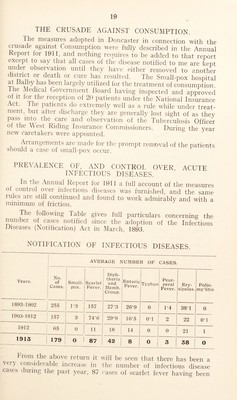
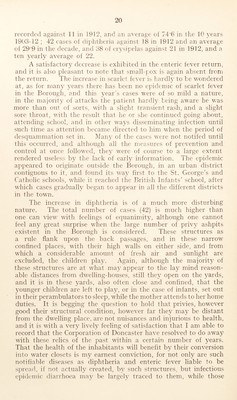
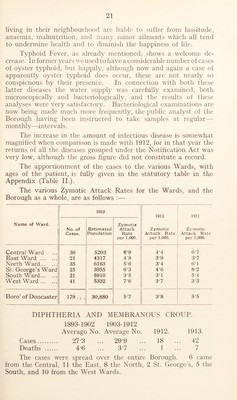
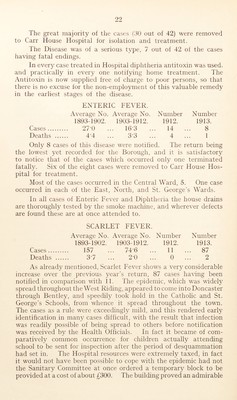
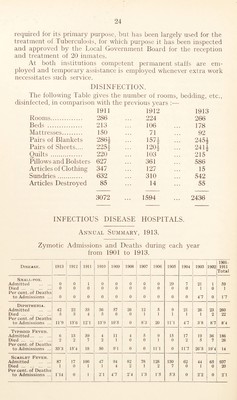
![recorded against 11 in 1912, and an average of 74'6 in the 10 years 1903-12 ; 42 eases of diphtheria against 18 in 1912 and an average of 29*9 in the decade, and 38 of erysipelas against 21 in 1912, and a ten yearly average of 22. A satisfactory decrease is exhibited in the enteric fever return, and it is also pleasant to note that small-].ox is again absent from the return. The increase in scarlet fever is hardlv to be wondered at, as for many years there has been no epidemic of scarlet fever in the Borough, and this year’s cases were of so mild a nature, in the majority of attaeks the patient hardl}' being aware he was more than out of sorts, with a slight transient rash, and a slight sore throat, with the result that he or she continued going about, attending school, and in other ways disseminating infection until such time as attention became directed to him when the period of desquammation set in. Many of the cases were not notifed until this occurred, and although all the measures of prevention and control at once followed, they were of course to a large extent rendered useless b}/ the lack of early information. The epidemic appeared to originate outside the Borough, in an urban district contiguous to it, and found its way first to the St. George’s and Catholic schools, while it reached the British Infants’ school, after which cases gradually began to appear in all the different districts in the town. The increase in diphtheria is of a much more disturbing nature. The total number of cases (42) is much higher than one can view with feelings of equanimity, although one cannot feel any great surprise when the large number of privy ashpits existent in the Borough is considered. These structures as a rule flank upon the back passages, and in these narrow confined places, with their high walls on either side, and from which a considerable amount of fresh air and sunlight are excluded, the children play. Again, although the majorit}^ of these structures are at what may appear to the lay mind reason- able distances from dwelling-houses, still they open on the yards, and it is in these yards, also often close and confined, that the younger children are left to play, or in the case of infants, set out in their perambulators to sleep, while the mother attends to her home duties. It is begging the question to hold that privies, however good their structural condition, however far they may be distant from the dwelling place, are not nuisances and injurious to health, and it is with a very lively feeling of satisfaction that I am able to record that the Corporation of Doncaster have resolved to do away with these relics of the past within a certain number of years. That the health of the inhabitants will benefit by their conversion into water closets is my earnest conviction, for not only are such notifiable diseases as diphtheria and enteric fever liable to be spread, if not actually created, by such structures, but infectious epidemic diarrhoea may be largely traced to them, while those](https://iiif.wellcomecollection.org/image/b29162889_0020.jp2/full/800%2C/0/default.jpg)