Principles of human physiology : with their chief applications to pathology, hygiene and forensic medicine / by William B. Carpenter.
- William Benjamin Carpenter
- Date:
- 1846
Licence: Public Domain Mark
Credit: Principles of human physiology : with their chief applications to pathology, hygiene and forensic medicine / by William B. Carpenter. Source: Wellcome Collection.
Provider: This material has been provided by The University of Glasgow Library. The original may be consulted at The University of Glasgow Library.
778/814 (page 744)
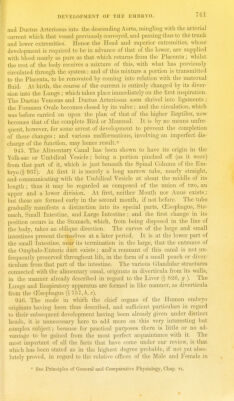
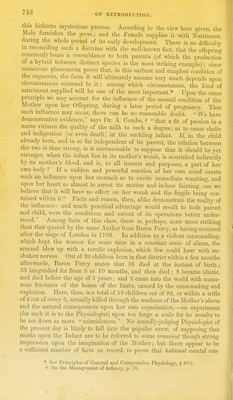
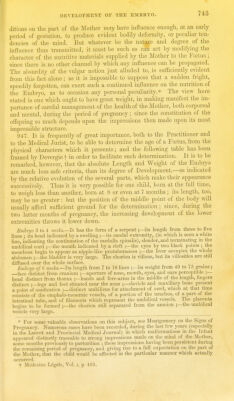
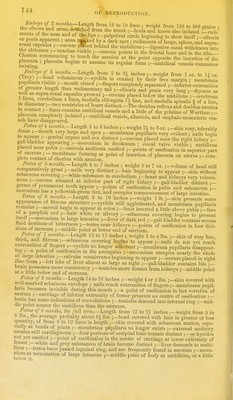
![Embryo of 2 months—Length from 16 to 19 lines ; weight from 150 to 300 grains • ments of the nose and of the hps ^-palpebral circle beginning to show itself --clitoris or perns apparent; anus mftked by a dark spot; rudiments ofhm^J^ mi ^ renal capsules j-ccecum pTced behind the umbilicus ;-digestive S3tSKSK ti e abdomen ;-urachus visible ;-osseous points in the frontal bone and in the ribs— rilZ'Z ?0mmeu+cm? *? touch the amnion at the point opposite the insertion of the twlstmg P ^ aSSUmC HS rCgUlar form 5-imbaical vessels commence nSSTtf 3, m<^«-Lengfl» from 2 to 2* inches ;-weight from 1 oz. to 14 oz. (lioy) ,-head voluminous ;-eyehds in contact by their free margin ; membrana lZ£Z^lh l^rnthZ °Sed ;-finS^ completely separated ;_mferior extremities of greater length than rudimentary tail ;-clitoris and penis very long ;-thymus as well as supra-renal capsules present ;-ccecum placed below the umbihcuV ;-cerebrum 5 hues, cerebellum 4 lines medulla oblongata 1£ hne, and medulla spinalis 4 of a line, m diameter ;-two ventricles of heart distinct—The decidua reflexa and decidua uterina in contact j—funis contains umbilical vessels and a little of the gelatine of Warthon •— sekChaveXappeared0kted;~UmbiliCal vesicle> allantois> and omphalomesenteric v'es- aITS t4 ™(mths--J'™gtiiJ to 6 inches ;-weight 24. to 3 oz. ;_skin rosy, tolerably dense —mouth very large and open j-membrana pupillaris very evident; nails begih to appear ;-gemtal organs and sex distinct ;—coecum placed near the right kidneY •— gall-bladder appearing ^meconium in duodenum ; ccecal valve visible : umbilicus placed near pubis ;-ossicula auditoria ossified points of ossification in superior part ol sacrum ; - membrane forming at point of insertion of placenta on uterus :-com- plete contact of chorion with amnion. oZT'f ? mont\s--^?$h 6 to 7 inches ; weight 5 to 7 oz. ;-volume of .head still comparatively great ;-nails very distinct ;-hair beginning to appear ;-skin without sebaceous covering ;—white substance in cerebellum ;—heart and kidneys very volumi- nous ;-coecum situated at inferior part of right kidney ;-gall-bladder distinct ;— germs of permanent teeth appeal-;—points of ossification in pubis and calcaneum — meconium has a yellowish-green tint, and occupies commencement of large intestine. Foetus of G raonths.-Length 9 to 10 inches weight 1 lb. ;-skin presents some appearance of fibrous structure ;-eyelids still agglutinated, and membrana pupiUaris remains ;—saccuh begin to appear in colon;—funis inserted a little above pubis ;—face of a purplish red ;—hair white or silvery ;—sebaceous covering begins to present itself ;-meconium m large intestine ;-]iver of dark red ;—gall-bladder contains serous fluid destitute of bitterness ;—testes near kidneys ;—points of ossification in four divi- sions ot sternum ;—middle point at lower end of sternum. Foetus 0/ 7 months.—Length 13 to 15 inches ; weight 3 to 4 lbs. skin of rosy hue, thick, and fibrous j—sebaceous covering begins to appear;—nails do not yet reach extremities of fingers ;-eyehds no longer adherent;—membrana pupiUaris disappear- 1fS,;—a Pomt.ot ossification m the astragalus ;—meconium occupies nearly the whole ol large mtestme ;—valvulee conniventes beginning to appeal-;—coecum placed in right iliac fossa j—left lobe of liver almost as large as right;—gall-bladder contains bile;— brain possesses more consistency ;—testicles more distant from kidneys :—middle point at a httle below end of sternum. Foetus of 8 months.—Length 14 to 16 inches ;—weight 4 or 5 lbs.;—skin covered with well-marked sebaceous envelope ; nails reach extremities of fingers;—membrana pupil- fans becomes invisible during this month ;—a point of ossification in last vertebra of sacrum;—cartilage of inferior extremity of femur presents no centre of ossification ;— brain has some indications of convolutions ;—testicles descend into internal ring :—mid- dle point nearer the umbilicus than the sternum. Foetus of 9 months, the full term.—Length from 17 to 21 inches;—weight from 5 to 9 lbs., the average probably about 6,]- lbs.;—head covered with hair in greater or less quantity, of from 9 to 12 lines in length;—skin covered with sebaceous matter, espe- cially at bends of joints ;—membrana pupiUaris no longer exists ;—external auditory meatus still cartilaginous ;—four portions of occipital bone remain distinct;—os hyoides not yet ossified ;—point of ossification in the centre of cartilage at lower extremity of femur;—wlute and grey substances of brain become distinct ;—liver descends to umbi- licus ; testes have passed inguinal ring, and arc frequently found in scrotum ;—meco- nium at termination of large intestine ;—middle point of body at umbilicus, or a little](https://iiif.wellcomecollection.org/image/b21461776_0778.jp2/full/800%2C/0/default.jpg)