Licence: Public Domain Mark
Credit: Beriberi. Source: Wellcome Collection.
Provider: This material has been provided by the Gerstein Science Information Centre at the University of Toronto, through the Medical Heritage Library. The original may be consulted at the Gerstein Science Information Centre, University of Toronto.
16/460 page 4
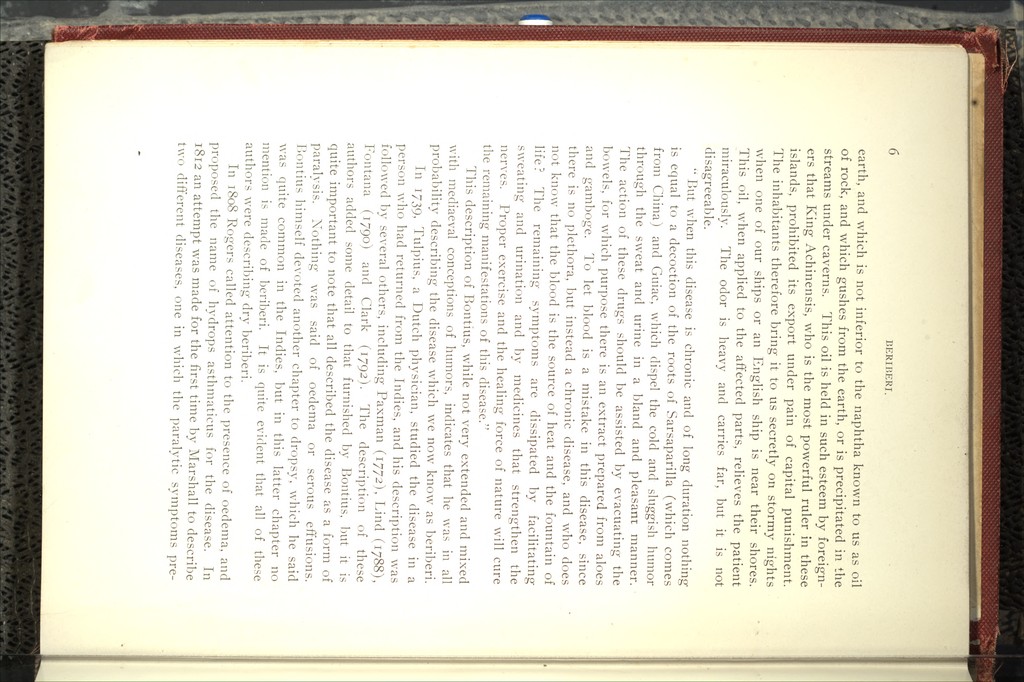
![probable that beriberi has long been present, even though it has only recently been recognized. A\^e have been unable to verify all of these references, but there can be little doubt that beriberi is a disease that occurred and was recognized in very ancient times. History in Modern Times. Most authors have given to Bou- tins the credit of being the first European physician to describe beriberi, but they say no more concerning his observations than they do of the reference to the Neidiing, and Castellani gives the date of his work as 1758-59. The library of the Bureau of Science, ^lanila, contains a volume published by Jacobus Bontius at Lugdum, Batavia, in 1642, and this is 1)elieved to be a first edition. It is entitled de Aledicina Indorum, and is in reality our first book on tropical medicine, containing among other matters descriptions of various eastern drugs, such as santal, betel, cassia, etc., rules for conserving the health in the tropics, and short chapters on beriberi, convulsions, dysentery, cholera, dropsy and other diseases. His article on 1)eri])eri is brief and interesting. The original may be found in the ap])cndix, l)ut a free translation is as follows: Chapter 1. Concerning a certain kind of paralysis which the inhal)itants call l)eril)eri. This is a certain exceedingly troul)les()me disease afi:ecting the people here which is called l)eriberi'(a word which sounds like the word for sheep) 1)y the inha1)itants, I believe l)ecause those attacked 1)y this disease walk like sheep, 1)ecause of their shaking knees and weakened legs. It is a kind of paralysis, or rather a tremor usually afi:ecting the movement and sensation of the hands and feet, but sometimes it attacks the whole 1)ody and causes it to shake. 1lie cause of this disease is principally a thick and slug- gish phlegmatic humor derived from the nocturnal dampness and from the rains which fall here continuously from the beginning of November to the beginning of May. This humor attacks the ner\'es, doubtless while men are exhausted l)y the heat of the dav. or at night when they throw ofi: all coverings and blankets, when this humor is generated most easily in the brain and invades the nerves. Xow the nights in these regions may be called cold as compared with the heat of the day, and on such occasions, while the limbs are extended, the ])hlegm insinuates itself between the joints in such a manner that the nerves and ligaments l^ecome relaxed. *' Although this di.-ease for the most part begins gradually and invades the bcxlv little bv little, nevertheless it is sometimes verv](https://iiif.wellcomecollection.org/image/b20995611_0016.jp2/full/800%2C/0/default.jpg)