A treatise on operative surgery : comprising a description of the various processes of the art, including all the new operations : exhibiting the state of surgical science in its present advanced condition / by Joseph Pancoast.
- Joseph Pancoast
- Date:
- 1844
Licence: Public Domain Mark
Credit: A treatise on operative surgery : comprising a description of the various processes of the art, including all the new operations : exhibiting the state of surgical science in its present advanced condition / by Joseph Pancoast. Source: Wellcome Collection.
Provider: This material has been provided by the National Library of Medicine (U.S.), through the Medical Heritage Library. The original may be consulted at the National Library of Medicine (U.S.)
22/562
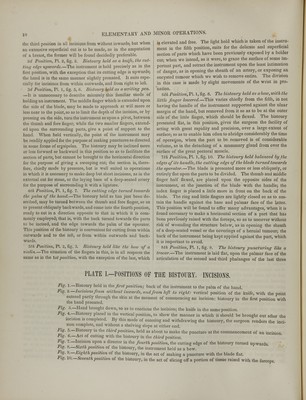
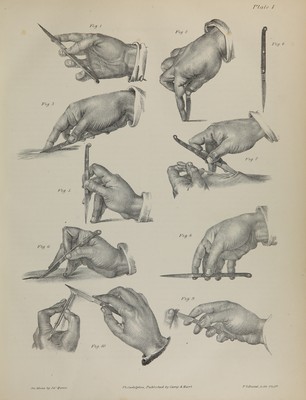
![10 ELEMENTARY AND MINOR OPERATIONS. the third position in all incisions from without inwards; but when an extensive superficial cut is to be made, as in the amputation of a breast, the former will be found decidedly preferable. Position, PI. 2, fig. 2. Bistoury held as a knife, the cut- edge upwards.—The instrument is held precisely as in the fust position, with the exception that its cutting edge is upwards; the hand is in the same manner slightly pronated. It suits espe- cially for incisions from within outwards, and from right to left. 3d Position, PI. 1, fig. 5, 6. Bistoury held as a ivriting pen. —It is unnecessary to describe minutely this familiar mode of holding an instrument. The middle finger which is extended upon the side of the blade, may be made to approach at will more or less near to the point, so as to limit the depth of the incision, or by pressing on the side, turn the instrument as upon a pivot, between the thumb and fore finger; while the two smaller fingers, extend- ed upon the surrounding parts, give a point of support to the hand. When held vertically, the point of the instrument may be readily applied for the purpose of making punctures as directed in some forms of erysipelas. The bistoury may be inclined more or less forward or backward in this position so as to facilitate the section of parts, but cannot be brought to the horizontal direction for the purpose of giving a sweeping cut; the section is, there- fore, chiefly made by pressure, but is well suited to operations in which it is necessary to make deep but short incisions, as in the external cut for stone, or the laying bare of a deep-seated artery for the purpose of surrounding it with a ligature. 4th Position, PI. 1, fig. 7. The cutting edge turned toivards the palm of the hand.—The bistoury held as has just been de- scribed, may be turned between the thumb and fore finger, so as to present obliquely backwards, and come into the fourth position, ready to cut in a direction opposite to that in which it is com- monly employed; that is, with the back turned towards the parts to be incised, and the edge towards the palm of the operator. This position of the bistoury is convenient for cutting from within outwards and to the left, or from within outwards and back- wards. 5th Position, PI. 2, fig. 3. Bistoury held like the bow of a violin.—The situation of the fingers in this, is in all respects the same as in the 1st positioti, with the exception of the last, which is elevated and free. The light hold which is taken of the instru- ment in the fifth position, suits for the delicate and superficial section of parts which have been previously exposed by a bolder cut; when we intend, as it were, to graze the surface of some im- portant part, and retract the instrument upon the least intimation of danger, as in opening the sheath of an artery, or exposing an encysted tumour which we wish to remove entire. The division in this case is made by slight movements of the wrist in pro- nation. 6th Position, PI. 1, fig. 8. The bistoury held as a bow, with the little finger lowered.—This varies chiefly from the fifth, in not having the handle of the instrument supported against the ulnar margin of the hand, but removed from it so as to be at the outer side of the little finger, which should be flexed. The bistoury presented flat, in this position, gives the surgeon the facility of acting with great rapidity and precision, over a large extent of surface; so as to enable him often to abridge considerably the time of operation, when the part to be removed is of considerable volume, as in the detaching of a mammary gland from over the surface of the great pectoral muscle. 1th Position, PI. 1, fig. 10. The bistoury held balanced by the edges of its handle, the cutting edge of the blade turned towards the operator.—The blade is presented more or less obliquely, or entirely flat upon the parts to be divided. The thumb and middle finger half flexed, are placed upon the opposite sides of the instrument, at the junction of the blade with the handle; the index finger is placed a little more in front on the back of the blade. The ring and little fingers are lightly closed so as to sus- tain the handle against the base and palmar face of the latter. This position will be found to offer many advantages, when it is found necessary to make a horizontal section of a part that has been previously raised with the forceps, so as to uncover without risk of wounding the structure below, as in opening the sheath of a deep-seated vessel or the coverings of a hernial tumour; the back of the instrument being kept applied against the part, which it is important to avoid. 8th Position, PI. ], fig. 9. The bistoury puncturing like a trocar.—The instrument is laid flat, upon the palmar face of the articulation of the second and third phalanges of the last three PLATE L—POSITIONS OF THE BISTOURY. INCISIONS. Fig Fig Fit FU Fig Fig Fig, Fig, Fig, Fig . 1.—Bistoury held in the first position; back of the instrument to the palm of the hand. 2.—Incisions from ivithout inivards, and from left to right: vertical position of the knife, with the point entered partly through the skin at the moment of commencing an incision: bistoury in the first position with the hand pronated. . 3.—Hand brought down, so as to continue the incision; the knife in the same position. .4.—Bistoury placed in the vertical position, to show the manner in which it should be brought out after the incision is completed. By this mode of entering and withdrawing the bistoury, the surgeon renders the inci- sion complete, and without a shelving slope at either end. 5.—Bistoury in the third position, held as about to make the puncture at the commencement of an incision . 6.—Act of cutting with the bistoury in the third position. 7.—Incision upon a director in the fourth position, the cutting edge of the bistoury turned upwards 8.—Sixth position of the bistoury, the instrument held as a bow. 9.—Eighth position of the bistoury, in the act of making a puncture with the blade flat. 10.—Seventh position of the bistoury, in the act of slicing off a portion of tissue raised with the forceps.](https://iiif.wellcomecollection.org/image/b21145398_0022.jp2/full/800%2C/0/default.jpg)