A visit to thirteen asylums for the insane in Europe : to which are added a brief notice of similar institutions in transatlantic countries and in the United States, and an essay on the causes, duration, termination and moral treatment of insanity, with copious statistics / by Pliny Earle.
- Pliny Earle
- Date:
- 1841
Licence: Public Domain Mark
Credit: A visit to thirteen asylums for the insane in Europe : to which are added a brief notice of similar institutions in transatlantic countries and in the United States, and an essay on the causes, duration, termination and moral treatment of insanity, with copious statistics / by Pliny Earle. Source: Wellcome Collection.
Provider: This material has been provided by the National Library of Medicine (U.S.), through the Medical Heritage Library. The original may be consulted at the National Library of Medicine (U.S.)
36/152
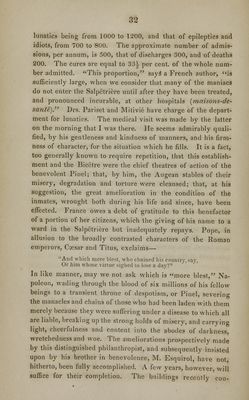
![lunatics being from 1000 to 1200, and that of epileptics and idiots, from 700 to 800. The approximate number of admis- sions, per annum, is 500, that of discharges 300, and of deaths 200. The cures are equal to 33^- per cent, of the whole num- ber admitted. This proportion, says' a French author, is sufficiently large, when we consider that many of the maniacs do not enter the Salpetriere until after they have been treated, and pronounced incurable, at other hospitals (maisons-de- sante). Drs. Pariset and Mitivie have charge of the depart- ment for lunatics. The medical visit was made by the latter on the morning that I was there. He seems admirably quali- fied, by his gentleness and kindness of manners, and his firm- ness of character, for the situation which he fills. It is a fact, too generally known to require repetition, that this establish- ment and the Bicetre were the chief theatres of action of the benevolent Pinel; that, by him, the Augean stables of their misery, degradation and torture were cleansed; that, at his suggestion, the great amelioration in the condition of the inmates, wrought both during his life and since, have been effected. France owes a debt of gratitude to this benefactor of a portion of her citizens, which the giving of his name to a ward in the Salpetriere but inadequately repays. Pope, in allusion to the broadly contrasted characters of the Roman emperors, Cassar and Titus, exclaims— And which more blest, who chained his country, say, Or him whose virtue sighed to lose a day] In like manner, may we not ask which is more blest, Na- poleon, wading through the blood of six millions of his fellow beings to a transient throne of despotism, or Pinel, severing the manacles and chains of those who had been laden with them merely because they were suffering under a disease to which all are liable, breaking up the strong holds of misery, and carrying light, cheerfulness and content into the abodes of darkness, wretchedness and woe. The ameliorations prospectively made by this distinguished philanthropist, and subsequently insisted upon by his brother in benevolence, M. Esquirol, have not, hitherto, been fully accomplished. A few years, however will suffice for their completion. The buildings recently con-](https://iiif.wellcomecollection.org/image/b21117172_0036.jp2/full/800%2C/0/default.jpg)