Volume 1
An Egyptian hieroglyphic dictionary : With an index of English words, king list and geographical list with indexes, list of hieroglyphic characters, Coptic and Semitic alphabets, etc / by Sir E.A. Wallis Budge.
- E. A. Wallis Budge
- Date:
- 1920
Licence: In copyright
Credit: An Egyptian hieroglyphic dictionary : With an index of English words, king list and geographical list with indexes, list of hieroglyphic characters, Coptic and Semitic alphabets, etc / by Sir E.A. Wallis Budge. Source: Wellcome Collection.
11/756
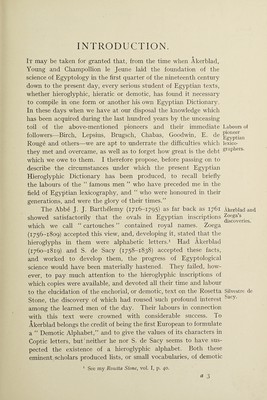
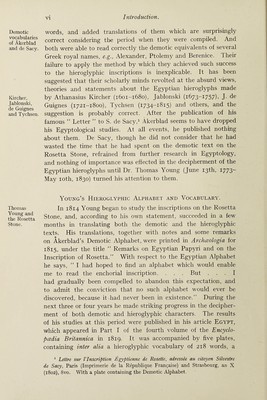
![INTRODUCTION. o It may be taken for granted that, from the time when Akerblad, Young and Champollion le Jeune laid the foundation of the science of Egyptology in the first quarter of the nineteenth century down to the present day, every serious student of Egyptian texts, whether hieroglyphic, hieratic or demotic, has found it necessary to compile in one form or another his own Egyptian Dictionary. In these days when we have at our disposal the knowledge which has been acquired during the last hundred years by the unceasing toil of the above-mentioned pioneers and their immediate Labours of followers—Birch, Lepsius, Brugsch, Chabas, Goodwin, E. de ]?°ypqan Rouge and others—we are apt to underrate the difficulties which lexico- they met and overcame, as well as to forget how great is the debt §raPhers- which we owe to them. I therefore propose, before passing on to describe the circumstances under which the present Egyptian Hieroglyphic Dictionary has been produced, to recall briefly the labours of the “ famous men ” who have preceded me in the field of Egyptian lexicography, and “ who were honoured in their generations, and were the glory of their times.” The Abbe J. J. Barthelemy (1716-1795) as far back as 1761 Akerblad and showed satisfactorily that the ovals in Egyptian inscriptions Zoega’s J J discoveries. which we call “ cartouches ” contained royal names. Zoega (1756-1809) accepted this view, and, developing it, stated that the hieroglyphs in them were alphabetic letters.1 Had Akerblad (1760-1819). and S. de Sacy (1758-1838) accepted these facts, and worked to develop them, the progress of Egyptological science would have been materially hastened. They failed, how¬ ever, to pay much attention to the hieroglyphic inscriptions of which copies were available, and devoted all their time and labour to the elucidation of the enchorial, or demotic, text on the Rosetta Silvestre de Stone, the discovery of which had roused such profound interest Sacy‘ among the learned men of the day. Their labours in connection with this text were crowned with considerable success. To Akerblad belongs the credit of being the first European to formulate a “ Demotic Alphabet,” and to give the values of its characters in Coptic letters, but'neither he nor S. de Sacy seems to have sus¬ pected the existence of a hieroglyphic alphabet. Both these eminent scholars produced lists, or small vocabularies, of demotic 1 See my Rosetta Stone, vol. I, p. 40. « 3](https://iiif.wellcomecollection.org/image/b29930571_0001_0011.jp2/full/800%2C/0/default.jpg)