Volume 1
An Egyptian hieroglyphic dictionary : With an index of English words, king list and geographical list with indexes, list of hieroglyphic characters, Coptic and Semitic alphabets, etc / by Sir E.A. Wallis Budge.
- E. A. Wallis Budge
- Date:
- 1920
Licence: In copyright
Credit: An Egyptian hieroglyphic dictionary : With an index of English words, king list and geographical list with indexes, list of hieroglyphic characters, Coptic and Semitic alphabets, etc / by Sir E.A. Wallis Budge. Source: Wellcome Collection.
16/756
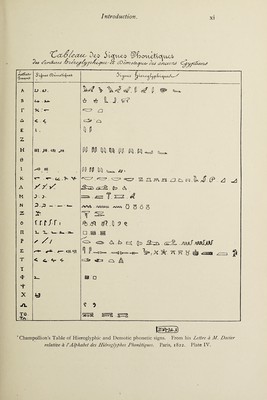
![Champol lion’s Hieroglyphic Alphabet. Kosegarten’s testimony. sometimes that which is merely the most readily ascertained or distinguished.”1 Now although Young was the first to apply the phonetic, or alphabetic, principle to Egyptian hieroglyphs, it is quite clear from the above that he failed to see its value in arranging Egyp¬ tian words in a dictionary. Speaking of Champolhon’s alphabet, which was in reality his own with modifications and considerable additions, he says : “ His system of phonetic characters may often be of use in assisting the memory, but it can only be applied with confidence to particular cases when supported in each case by the same kind of evidence that had been employed before its invention. His communications have furnished many valuable additions to this work, all of which have been acknowledged in their proper places.” So then rejecting his own system of phonetic, i.e. alphabetic, characters, and Champollion’s develop¬ ment of it, he drew up his “ Rudiments of the Egyptian Dic¬ tionary in the ancient Enchorial Character,” intending the work to appear as an Appendix to the ” Coptic Grammar,” which Henry Tattam was then writing. Whilst the printing of the “ Rudiments ” was in progress he fell ill, but his interest in the work was so great that in spite of his illness he continued to prepare its pages for the lithographer and to correct the proofs. When he had passed for press six sheets, i.e. 96 pages, death overtook him, and Tattam corrected the last 14 pages (pp. 97-110) of proof, saw them through the press, and compiled an Index to the work, which appeared with Tattam’s “ Coptic Grammar ” in 1 Writing to M. Arago on July 4th, 1828, Young says, “ Now of the nine letters which I insist that I had discovered, M. Champollion himself allows me five, and I maintain that a single one would have been sufficient for all that I wished to prove ; the method by which that one was obtained being allowed to be correct, and to be capable of further application. The true foundation of the analysis of the Egyptian system, I insist, is the great fact of the original identity of the enchorial with the sacred characters, which I discovered and printed in 1816 [in the Museum Cnticum No. VI, pp. 155-204], and which M. Champollion probably rediscovered, and certainly republished in 1821 ; besides the reading of the name of Ptolemy, which I had completely ascertained and published in 1814, and the name of Cleopatra, which Mr. Bankes had afterwards discovered by means of the information that I had sent him out to Egypt, and which he asserts that he communicated indirectly to M. Champollion [see H. Salt, Essay on Dr. Young s and M. Champollion’s Phonetic System of Hieroglyphics, London, 1825, p. 7] ; and whatever deficiencies there might have been in my original alphabet, supposing it to have contained but one letter correctly determined, they would and must have been gradually supplied by a continued application of the same method to other monuments which have been progressively discovered and made public since the date of my first paper.” Leitch, Miscellaneous Works of the late Thomas Young, M.D., F.R.S., Vol. Ill, p. 464 ff.](https://iiif.wellcomecollection.org/image/b29930571_0001_0016.jp2/full/800%2C/0/default.jpg)