Volume 1
An Egyptian hieroglyphic dictionary : With an index of English words, king list and geographical list with indexes, list of hieroglyphic characters, Coptic and Semitic alphabets, etc / by Sir E.A. Wallis Budge.
- E. A. Wallis Budge
- Date:
- 1920
Licence: In copyright
Credit: An Egyptian hieroglyphic dictionary : With an index of English words, king list and geographical list with indexes, list of hieroglyphic characters, Coptic and Semitic alphabets, etc / by Sir E.A. Wallis Budge. Source: Wellcome Collection.
26/756
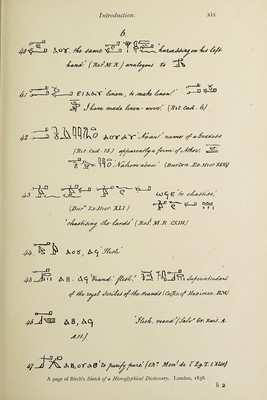
![His ideophonetic arrangement. Arrangement of the proposed Dictionary. Polyphonous symbols. Natural classification of symbols. The tabulated symbols to form the key. M. Champollion, and of their application to the monuments of the Egyptians.” The dictionary does not claim even comparative perfection, “but it has been judged that the publication of such a work might be of slight service to those who are desirous of possessing, in a compendious form, the results of much labour, comparison and instruction.” The matter contained in the work is not entirely original, but the arrangement is, and “ if not scientific, [it is] perhaps the only one by which tyros could at once find the particular group or word which they seek. It may be termed ideophonetic, as it embraces both principles of ideal and phonetic classification, and its arrangement has been borrowed from a language very cognate in its construction—the Chinese.” The hieroglyphical and English part of the Dictionary was to be divided into two parts. Part I was to contain words “ com¬ mencing with symbols, representatives of sounds, or phonetic,” and Part II words “ whose initial character is the equivalent of an idea, or ideographic.” Part I was to be “ subdivided into symbols, having the power of vowels or consonants, the vowels forming (on account of one symbol frequently having the force of many) one large class, and the consonants, according to their position in the Coptic alphabet.” That is to say, Division I of Part I was to contain symbols or characters some of which Birch held to be polyphonous, and Division II symbols to which he had given consonantal values, and these were to be arranged in the order of the letters of the Coptic Alphabet. The internal classification of the characters or symbols was to be strictly ideographical, taking the symbols in their arrangement, according to the rank they hold in natural and other sciences, as the human form, limbs, animals, inanimate objects, etc.” At the end of the Dictionary Birch intended to give “all the symbols in a similar classification, and in a tabular view,” and this section was to form the key to the whole work. With the view of illustrating the way in which he intended his Dictionary to be used, he says, “ Suppose, for example, it were required to find the meaning of a group beginning with a human eye [o>-]—as the eye is a component part of the human body, it will be found in that division in the table, and there will be affixed to the depicted eye, v[ide Nos] 13-43.” In this group of words will be found all those words in which an eye [^s^] is the first character ; and the eye generally represents a vowel. These remarks will be clear to the reader after examining the two pages from Birch’s “ Sketch of a Hieroglyphical Dictionary,” which are reproduced on pp. xviii](https://iiif.wellcomecollection.org/image/b29930571_0001_0026.jp2/full/800%2C/0/default.jpg)