Flora of the British West Indian Islands / by A.H.R. Grisebach.
- August Grisebach
- Date:
- 1864
Licence: Public Domain Mark
Credit: Flora of the British West Indian Islands / by A.H.R. Grisebach. Source: Wellcome Collection.
Provider: This material has been provided by Royal College of Physicians, London. The original may be consulted at Royal College of Physicians, London.
15/840 page 11
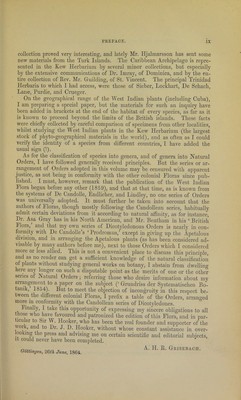
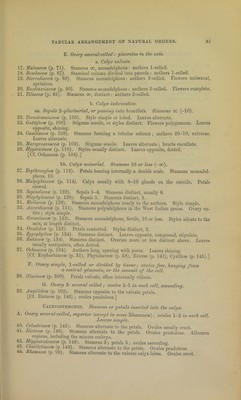
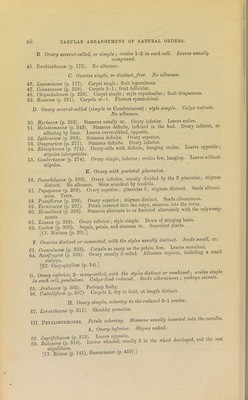
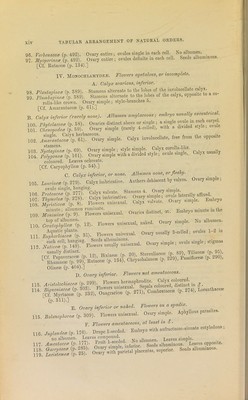
![E. Ovary several-celled: placentas in the axis. a. Calyx valvate. 17. Malvaceae (p. 71). Stamens 00, monadelphous: anthers 1-celled. 18. Bombacece (p. 87). Staminal column divided into parcels : anthers 1-celled. 19. Sterculiacece (p. 89). Stamens monadelphous: anthers 2-celled. Flowers unisexual, apetalous. 20. Bnettneriacece (p. 90). Stamens monadelphous : anthers 2-celled. Flowers complete. 21. Tiliacece (p. 95). Stamens co, distinct: anthers 2-celled. b. Calyx imbricative. aa. Sepals 2-pluriserial, or passing into bractlets. Stamens co (-10). 22. Temstroemiacece (p. 103). Style simple or lobed. Leaves alternate. 23. Guttiferee (p. 108). Stigmas sessile, or styles distinct. Flowers polygamous. Leaves opposite, shining. 24. Canillacece (p. 108). Stamens forming a tubular column; anthers 20-10, extrorse. Leaves alternate. 25. Marcgraaviacece (p. 109). Stigmas sessile. Leaves alternate ; bracts cucullate. 26. Rypericinece (p. 110). Styles usually distinct. Leaves opposite, dotted. [Cf. Oclmaceie (p. 104).] bb. Calyx uniserial. Stamens 10 or less (-00). 27. Erythroxylece (p. 113). Petals bearing internally a double scale. Stamens monadel- phous, 10. 28. Malpighiacece (p. 114). Calyx usually with 8-10 glands on the outside. Petals clawed. 29. Sapinclacece (p. 122). Sepals 5-4. Stamens distinct, usually 8. 30. Staphyleacea (p. 128). Sepals 5. Stamens distinct, 5. 31. Meliacex (p. 128). Stamens monadelphous nearly to the anthers. Style simple. 32. Aurantiacece (p. 131). Stamens polyadelphous in the West Indian genus. Ovary en- tire ; style simple. 33. Geraniacex (p. 132). Stamens monadelphous, fertile, 10 or less. Styles adnate to the axis, at length distinct. 34. Oxalidece (p. 132). Petals contorted. Styles distinct, 5. 35. Zygophyllea: (p. 134). Stamens distinct. Leaves opposite, compound, stipulate. 36. Rutacece (p. 134). Stamens distinct. Ovaries more or less distinct above. Leaves usually exstipulale, often dotted. 37. Ochnacea (p. 104). Anthers long, opening with pores. Leaves shining. [Cf. Euphorbiaceee (p. 31), Phytolacceae (p. 58), Erieese (p. 141), Cyrilles (p. 145).] F. Ovary simple, 1-celled or divided by tissue; ovules feiv, hanging from a central placenta, or the summit of the cell. 38. Olacinea (p. 309). Petals valvate, often internally villous. - G-. Ovary 2- several celled ; ovules 2-1 in each cell, ascending. 39. Ampitidem (p. 102). Stamens opposite to the valvate petals. [Cf. Ilicinese (p. 146); ovules peudulous.] Calycostemones. Stamens or petals inserted into the calyx. A. Ovary several-celled, superior (except in some Rhamneae); ovules 1-2 in each cell. Leaves simple. 40. Celastrinece (p. 145). Stamens alternate to the petals. Ovules usual!)' erect. 41. Ilicinete (p. 146). Stamens alternate to the petals. Ovules peuduious. Albumen copious, including the minute embryo. 42. IJipponrateacece (p. 148). Stamcus 3 ; petals 5 ; ovules ascending. 43. Chailleliacece (p. 149). Stamens alternate to the petals. Ovules peudulous. hamncai (p. 99). Stamens alternate to the valvate calyx-lobes. Ovules erect.](https://iiif.wellcomecollection.org/image/b2475691x_0015.jp2/full/800%2C/0/default.jpg)


 No text description is available for this image
 No text description is available for this image
 No text description is available for this image