Volume 2
The gardens and menagerie of the Zoological Society delineated / Published, with the sanction of the council, under the superintendence of the secretary and vice-secretary of the society.
- Zoological Society of London
- Date:
- 1831
Licence: Public Domain Mark
Credit: The gardens and menagerie of the Zoological Society delineated / Published, with the sanction of the council, under the superintendence of the secretary and vice-secretary of the society. Source: Wellcome Collection.
303/352 page 291
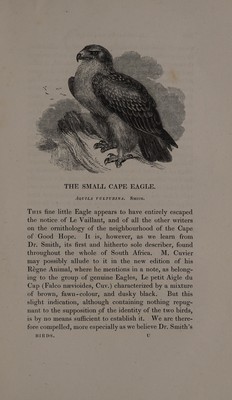
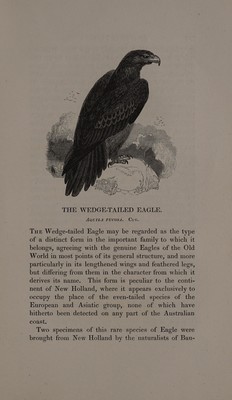
![THE SMALL CAPE EAGLE. 29] evidently cut from some publication, probably a news- paper. We should conjecture that this might be the South African Commercial Advertiser, a journal in which many scientific papers have, we believe, been from time to time communicated to the inhabitants of Cape Town and the neighbouring settlements, but to which we regret that we have it not in our power to refer. The description, which Dr, Smith states to be taken from a female, is as follows. The reader will observe that the primary and secondary quill-feathers are twice described, and with some little discrepancy ; for the reason above given, we cannot pretend to reconcile the apparent contradiction. “ Front, crown, neck, interscapulars, and back, pale tawny, with here and there brownish variegations ; tail-coverts tawny or dirty white; shoulders varied tawny and dark brown; scapulars blackish brown, more or less distinctly tipped with reddish white ; primary quill-feathers blackish brown, some of them edged on outer vanes with tawny red, and all tipped with reddish white ; secondaries dark dirty brown nar- _ rowly edged and tipped with reddish white; primary quill-feathers black; secondaries blackish brown on their outer vanes, on the inner grayish variegated by many transverse dark bands; tips of all reddish tawny; tail rounded, brownish gray, and much mottled by partial indistinct dusky black transverse narrow bands ; tips of feathers all tawny; under parts tawny with brown variegations, particularly numerous on the flanks and anterior part of the belly ; thighs dark ferruginous ; toes and cere yellow; claws dark horn-coloured ; bill a livid blue towards cere, dark horn-coloured towards apex; eyes reddish brown. Length of bird about two feet four inches ; feeds commonly upon carrion; and is generally found in company with vultures throughout u 2](https://iiif.wellcomecollection.org/image/b29348250_0002_0303.jp2/full/800%2C/0/default.jpg)