Volume 2
The gardens and menagerie of the Zoological Society delineated / Published, with the sanction of the council, under the superintendence of the secretary and vice-secretary of the society.
- Zoological Society of London
- Date:
- 1831
Licence: Public Domain Mark
Credit: The gardens and menagerie of the Zoological Society delineated / Published, with the sanction of the council, under the superintendence of the secretary and vice-secretary of the society. Source: Wellcome Collection.
333/352 page 321
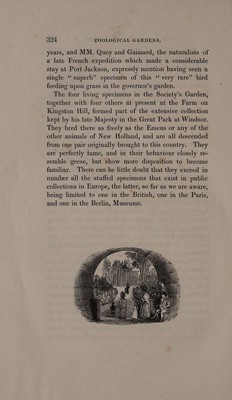
![west eastward to Bass’s Strait. Swan Isles, in Banks’s Strait, were so called by Captain Flinders, “ because a European who belonged to the Sydney-cove [a vessel wrecked near that locality] had assured him that he had met with vast numbers of breeding swans upon them;” but Mr. Bass subsequently ascertained that these swans were more like geese, and were the same species that he had previously seen upon Preservation Island. He describes them, in the account of his voyage quoted by Collins, as “ either a Brent or a Barnacle Goose, or between the two,” with a long slender neck, a short head, a rounded crown, a short thick arched bill, partly covered by a pea-green mem- brane, and dove-coloured plumage set with black spots. Flinders, who accompanied Bass on this occasion, iden- tifies the bird which he afterwards found at Lucky Bay and Goose Island, in the immediate vicinity of Espérance Bay, and which he justly regards as Labil- lardiére’s Swan, with that of Swan and Preservation Islands. It was found also in the latter locality by M. Bailly, one of Baudin’s officers, who in his relation inserted in Péron’s Voyage aux Terres Australes, speaks of the Geese which frequent those islands as forming a distinct species, characterized by their nearly uniform brown colour, varied only by round spots of a deeper colour than the rest and of about a centimetre (rather more than the third part of an inch) in diameter. And lastly, according to the oral information given by Mrs. Lewin to Dr. Latham, the Cereopsis is found “ in sufficient plenty in some parts of New Holland, and from its being so about Cape Barren, has obtained the name of Cape Barren Goose.” Cape Barren Island, it should be observed, is one of the largest of Furneaux’s group in Bass’s Strait, of which Preservation Island is also one. With these concurrent testimonies, now for BIRDS. y](https://iiif.wellcomecollection.org/image/b29348250_0002_0333.jp2/full/800%2C/0/default.jpg)