Iconograms : a collection of colored plates illustrating interesting surgical conditions / explanatory text, with special reference to diagnosis and treatment, by Faxton E. Gardner.
- Gardner, Faxton E. (Faxton Eugene), 1878-
- Date:
- [1913]
Licence: Public Domain Mark
Credit: Iconograms : a collection of colored plates illustrating interesting surgical conditions / explanatory text, with special reference to diagnosis and treatment, by Faxton E. Gardner. Source: Wellcome Collection.
Provider: This material has been provided by the Augustus C. Long Health Sciences Library at Columbia University and Columbia University Libraries/Information Services, through the Medical Heritage Library. The original may be consulted at the the Augustus C. Long Health Sciences Library at Columbia University and Columbia University.
29/548 page 7
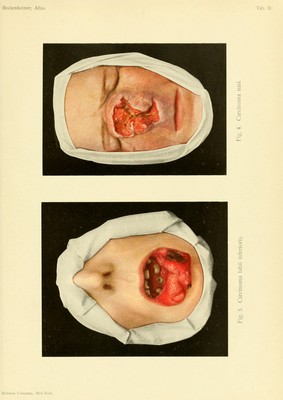
![hr;iiios cdvi'i-cd with ciiitlicliiiiii (cliccks, toiiniu', jioiiis, etc.). This is well slmwii ill Fig. 3, \\ln'i(' (l('c|) ulcerations alternate witii |i;ipill()iii.il(iiis growths. In sciiiic p.-irts llici'e are soal)s on tlie surface of tlie ulcers; in others isolated, yellow, epithelial i)lu.u;s. CarcinoMiii of the upper lip is very I'ai'c. A few cases have heen IMlhlislu'd ill wiiicli Mirh ;i c'l l-cilKilii.-i dc\'el(ipcd al'icr (Hie of the lower lip, in a syimiiet rical position. Carcinoma of the lower lip is almost exclusively a disease in the male sex, and seemingly more frerpient in smokers, although the part played by tobacco, admitted by a iiia.jority of writers, is stoutly denie(l liy others. Labial leucoplakia, similar to that observed on the tongue {Cf. Fig. 8), and closely allied, as is the later, to syphilis (see page 8), may degenerate into cancer. Antecedent tul)erculous disease also seems to be a cause favoi'ing the development of cancer. (Fig. 5 is an example of this mixed condition.) Cancer of the lower lip often begins at the junction of the skin with the vermilion border of the lip, generally between the midline and the angle of the mouth, as a small, hard nodule at first covered by mucous membrane. The latter soon becomes broken and the nodule grows, infiltrating the surrounding tissues rapidly, while the mucosa breaks down more and more, and thus is formed an ulcer. The whole of the lower lip may be gi-adually destroyed (Fig. 3)- Scabs and crusts form at several places on the ulcer, and when separated cause bleeding. In its early stages the cancer is only an ulcer with hard, raised edges and a crateriforni floor, but later ]iaiiillomatous proliferations spring from this floor (Fig. 3). The more the carcinoma extends, the more it implicates the underlying liones and the mucosa of the cheeks and floor of the mouth, so that all these structures may be completely destroyed. The exudation of growing cancer of the lip gives rise to marked cachexia, gastritis and enteritis, and the secre- tion maj^ reach the lungs and cause death from septic ]meumonia. In such inoperable forms the submaxillary and submental regions are usually lilleil with hard, fixed glands. UilJcnndal Dkiynosis Although these advanced runiis. which are often neglected, espe- cially in country people, are umnistakable, there may be difficulty in diagnosing a cancerous nicer in the early stage, when it is most important. The irregular, ragged surface of tlie carcinoma is in](https://iiif.wellcomecollection.org/image/b21221522_0029.jp2/full/800%2C/0/default.jpg)