Notes on the Naolpȧkhyȧnam, or Tale of Nala, for the use of classical students / [John Peile].
- Peile, John.
- Date:
- 1881
Licence: Public Domain Mark
Credit: Notes on the Naolpȧkhyȧnam, or Tale of Nala, for the use of classical students / [John Peile]. Source: Wellcome Collection.
23/260 page 11
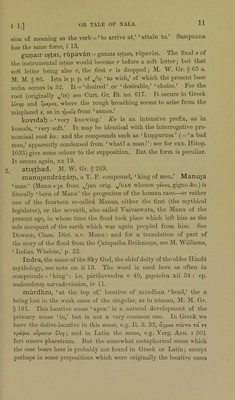
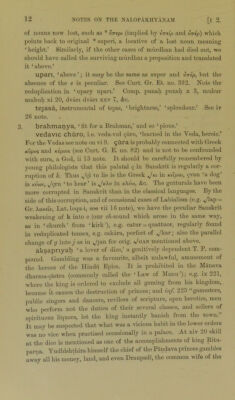
![sion of manning as the verb = ‘ to arrive at,’ ‘ attain to. Sanipanna has the same force, i 13. gunair istai, rupavan = gimais istais, rupavan. The final s of the instrumental istais would become r before a soft letter; but that soft letter being also r, the first r is dropped; M. W. Gr. § 65 a. M. M. § 86. Ista is p. p. of ‘ to wish,’ of which the present base iccha occurs ix 32. It =‘desired’ or ‘desirable,’ ‘choice.’ For the root (originally ^is) see Curt. Gr. Et. no. 617. It occurs in Greek ioTTjs and t/icpos, where the rough breathing seems to arise from the misplaced s, as in from ‘ asmes.’ kovidah = ‘ very knowing.’ Ko is an intensive prefix, as in komala, ‘ very soft.’ It may be identical with the inteiTOgative pro- nominal root hct: and the compounds such as ‘ kunpurusa (= ‘ a bad man,’ apparently condensed from ‘ whatl a man!’: see for exx. Hitop. 1033) give some colour to the supposition. But the form is peculiar. It occurs again, xx 19. atisthad. M. W. Gr. § 269. manujendranam, a T. P. compound, ‘king of men.’ Manuja ‘man’ (Manu-t-ja from Ji&n orig. ,yoAN whence-ycVos, gigno &c.) is literally ‘born of Manu’ the progenitor of the human race—or rather one of the fourteen so-called Manus, either the first (the mythical legislator), or the seventh, also called Vaivaswata, the Manu of the present age, in whose time the flood took place which left him as the sole occupant of the earth which was again peopled from him. See Dowson, Class. Diet. s.v. Man\i: and for a translation of part of the story of the flood from the Gatapatha Brahmana, see M. Williams, ‘ Indian Wisdom,’ p. 32. Indra, the name of the Sky God, the chief deity of the older Hindu mythology, see note on ii 13. The word is used here as often in compounds = ‘ king ’: i.e. piirthivendra v 40, gajendra xii 54: cp. mahendram sarvadeviinam, iv 11. murdhni, ‘at the top of,’ locative of murdhan ‘head,’ the a being lost in the weak cases of the singular, as in naman, M. M. Gr. § 191. This locative sense ‘upon’ is a natural development of the pi-imary sense ‘ in,’ but is not a very common one. In Greek we have the dative-locative in this sense, e.g. II. 5. 32, dypia irdvTtx to. re Tp€<^€i ovpea-Lv v\r]; and in Latin the same, e.g. Verg. Aen. i 501 fert umero pharetram. But the somewhat metaphorical sense which the case bears here is probably not found in Greek or Latin; except pei’haps in some prepositions which were oi'iginally the locative cases](https://iiif.wellcomecollection.org/image/b24851644_0023.jp2/full/800%2C/0/default.jpg)
 No text description is available for this image
 No text description is available for this image
 No text description is available for this image