Notes on the Naolpȧkhyȧnam, or Tale of Nala, for the use of classical students / [John Peile].
- Peile, John.
- Date:
- 1881
Licence: Public Domain Mark
Credit: Notes on the Naolpȧkhyȧnam, or Tale of Nala, for the use of classical students / [John Peile]. Source: Wellcome Collection.
25/260 page 13
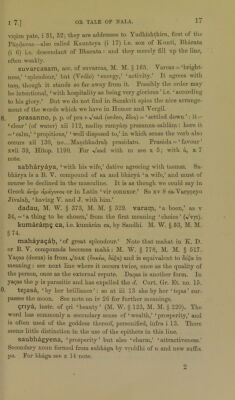
![I 3,] five brot]iers: ia consequence of which they are obliged to give up the kingdom to Duryodhana for twelve years and to live in the Kamyaka forest. The story of Nala is similar: hence that tale, as told to Yudhishthira, naturally recounts Nala’s taste for dice among his other high qualities. satya-vadi, ‘truth-speaking.’ Yadiu is a derivative of vada ‘ statement,’ formed by adding the suffix -in, a common formative element in Sanskrit, but not in other languages. So in line 1 balm is formed from bala ‘ strength.’ See M. W. Gr. § 85 vi: a useful list of Sanskrit formative suffixes is given §§ 80 — 87, and should be carefully read ; the suffixes common to other languages should also be studied in Schleicher, ‘Compendium,’ §§ 215—236. aksauhini, ‘ a complete army,’ from aksa (axle, axi-s, d^iov, also used of the whole car, not the same as ak.sa, dice), and iduni ‘ an assemblage,’ perhaps; from ,^/uh = vah ‘ to bear,’ and with vi ‘ to arrange.’ 4. ipsito, p. p. of ipsa, irregular desiderative (M. W. § 503) of ,^ap ‘to get’ (apiscor, &c.), =‘to desire:’ comp, abh’-ips-u, v 2. ‘Desired of noble women.’ Vara = ‘better’ from ^.^/vri ‘to choose’ iii 6 note; it is ‘ best ’ i 30, or ‘ excellent ’ as it might be rendered here: as a subst. it comes below, i 8. Note the genitive of the agent, so called, really only an extension of the subjective genitive. It is frequent in this poem with the peif. part., v 17 me Nisadho vritah, ix 29 bhisajam matam, xiii 40 me papakritam kritam, xvi 12 istem samasta-lokasya, ib. 32 bhratm- istam dvijottamam, xvii 41 tan nastem ubhayani tava, xxiv 3 pariksito me Vahukah: less frequent with the fut. part.; i 20 hantavyas te, xii 29 ko nu me va ’tha prastavyah, xix 15 pralabdhavya na te vayam. Compare the English ‘ seen of me; ’ but the origin of this use may be different. In Greek the genitive is no longer so used alone, but helped out by VITO for the sake of clearness : probably it rej^resents an original ablative. Generally in Sanskrit the instrumental is used *o rejjre- sent the agent (about 145 times in this poem), not distinguished, except by the sense, from the same case used of the instrument (about 135 times in this poem). In Latin the ablative had originally both functions (either borrowed from the instrumental, or pure ablative denoting the origin of the action): but, as is well known, the agent-ablative was almost universally distinguished from the instrument-ablative by the addition of ah. See note on hrida i 18, and, generally, ‘ Primer of Philology,’ c. v §§ 45, 46.](https://iiif.wellcomecollection.org/image/b24851644_0025.jp2/full/800%2C/0/default.jpg)