Notes on the Naolpȧkhyȧnam, or Tale of Nala, for the use of classical students / [John Peile].
- Peile, John.
- Date:
- 1881
Licence: Public Domain Mark
Credit: Notes on the Naolpȧkhyȧnam, or Tale of Nala, for the use of classical students / [John Peile]. Source: Wellcome Collection.
30/260 page 18
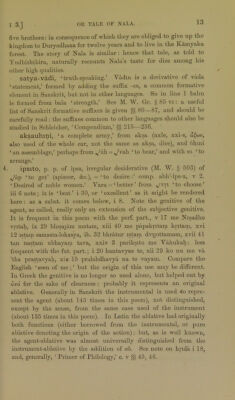
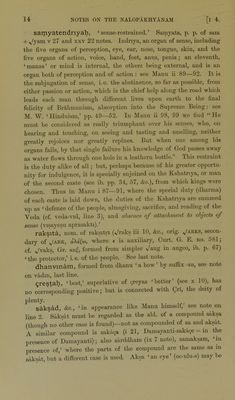
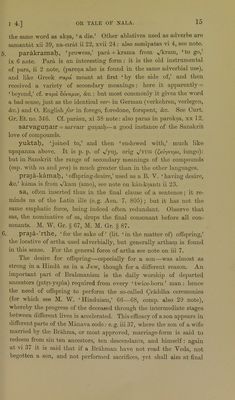
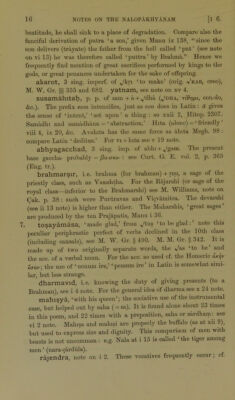
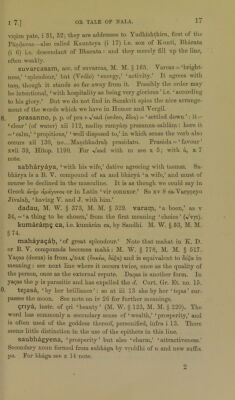
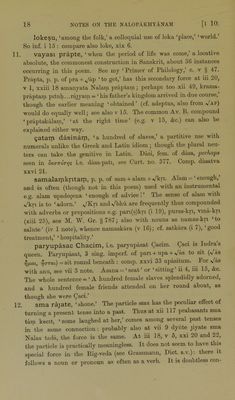
![lokesu, ‘among tlie folk,’ a colloquial use of loka ‘place,’ ‘world.’ So inf. i 15 : compare also loke, xix 6. 11. vayasi prapte, ‘when the period of life was come,’ a locative absolute, the commonest construction in Sanskrit, about 36 instances occunlng in this poem. See my ‘Primer of Philology,’ c. v § 47. Prapta, p. p. of pra + .^/ap ‘ to get,’ has this secondary force at iii 20, V 1, xxiii 18 amanyata Nalam praptarn; perhaps too xii 49, krama- praptam pituh...rajyain = ‘ his father’s kingdom arrived in due courae, though the earlier meaning ‘ obtained ’ (cf. adeptus, also from \/ap) would do equally well j see also v 15. The common Av. B. compound ‘ praptakalam,’ ‘at the right time’ (e.g. v 15, (kc.) can also be explained either way. qatarn dasinam, ‘a hundred of slaves,’ a partitive use with numerals unlike the Greek and Latin idiom ] though the plural neu- ters can take the genitive in Latin. Dasi, fem. of dasa, perlia'ps seen in SccrTroTTjs i.e. dasa-pati, see Curt. no. 211. Comp, d^atva xxvi 2i. samalamkritarn, p. p. of sum -t- alam + \/kri. Alam = ‘ enough,’ and is often (though not in this poem) used with an instrumental e.g. alam upadeqena ‘ enough of advice! ’ The sense of alam with Vkri is to ‘adorn.’ \/Kri andVbhu are frequently thus compounded with adverbs or prepositions e.g. pari(s)kri (i 19), puras-kn, vina-kri (xiii 25), see M. W. Gr. § 787; also with nouns as namas-kn ‘to salute’ (iv 1 note), whence namaskiira (v 16); cf. satkara (i /), ‘good treatment,’ ‘ hospitality.’ paryupasac Chacim, i.a paryupasat ^cim. Qaci is Indra’s queen. Paryupasat, 3 sing, imperf. of pan -I- upa + >/as to sit (Vas yfw.1, ijcrrat) =sit round beneath : comp, xxvi 33 upasitum. For >Jas with anu, see vii 3 note. Asana = ‘ seat ’ or ‘ sitting ’ ii 4, iii 15, &c. The whole sentence = ‘ A hundred female slaves splendidly adorned, and a hundred female friends attended on her round about, as though she were ^aci/ 12 sma rsjste, * shone/ The particle sma has the peculiar effect of turning a present tense into a past. Thus at xii 117 prahasanti sma tarn kecit, ‘ some laughed at her,’ comes among several past tenses in the same connection: probably also at vii 9 dyiite jiyate sma Nalas tada, the force is the same. At iii 18, v 6, xxi 20 and 22, the particle is practically meaningless. It does not seem to have this special force in the Rig-veda (see Grassmann, Diet, s.v.); there it follows a noun or pronoun as often as a verb. It is doubtless con-](https://iiif.wellcomecollection.org/image/b24851644_0030.jp2/full/800%2C/0/default.jpg)
 No text description is available for this image
 No text description is available for this image
 No text description is available for this image