Licence: Public Domain Mark
Credit: A treatise on surgical anatomy / by Abraham Colles. Source: Wellcome Collection.
Provider: This material has been provided by The University of Glasgow Library. The original may be consulted at The University of Glasgow Library.
20/238 page 6
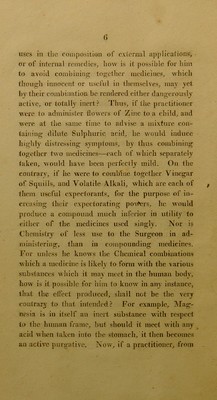
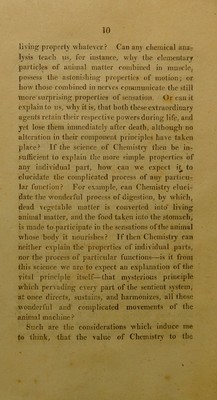
![uses ill tlie composition of cxicrnal a])plications, ■ or of internal remedies, liow is it possible for him to avoid combininp: together medicines, which though innocent or useful in themselves, rnaj yet by their combination be rendered either dangerously active, or totally inert? Thus, if the practitioner were to administer flowers of Zinc to a child, and were at the same time to advise a mixture con- taining dilute Sulphuric acid, he would induce highly distressing symptoms, by thus combining together two medicines—each of which separately taken, Avould have been perfectly mild. On the contrary, if he were to combine together Vinegar of Squills, and Volatile Alkali, which are each of tliem useful expectorants, for the purpose of in- creasing their expectorating po^^rs, lie would produce a compound much inferior in utility to either of the medicines used singly. Nor is Chemistry of less use to the Surgeon in ad- ministering, than in compounding medicines. For unless he knows the Chemical combinations which a medicine is likely to form with the various substances which it may meet in the human body, how is it possible for him to know in any instance, that the effect produced, shall not be the very contrary to that intended? For example. Mag- nesia is in itself an inert substance with respect to the liuman frame, but should it meet with any acid when taken into the stomach, it then becomes an active purgative. Now, if a practitioner, from](https://iiif.wellcomecollection.org/image/b24926000_0020.jp2/full/800%2C/0/default.jpg)