Introductory lecture to a course of military surgery : delivered in the University of Edinburgh, 1st May, 1850 / by Sir George Ballingall.
- George Ballingall
- Date:
- [1850]
Licence: Public Domain Mark
Credit: Introductory lecture to a course of military surgery : delivered in the University of Edinburgh, 1st May, 1850 / by Sir George Ballingall. Source: Wellcome Collection.
Provider: This material has been provided by The University of Glasgow Library. The original may be consulted at The University of Glasgow Library.
3/13 page 1
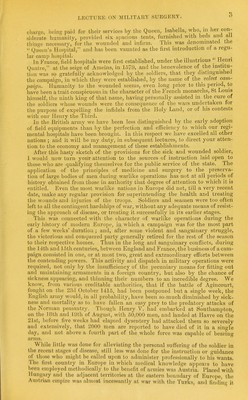
![IiNTRODUCTORY LECTURE TO A COURSE OF MILITARY SURGERY. DEtlVEBKO IN THE UNIVERSITY OF EDINBURGH, IST MaY 1850. nv Sm GEORGE BALLINGALL, M.D., F.R.S.E., PROFESSOR OF MILITARY SUIISEUY IN THE UNIVERSITY OF EDINBURGH. [from the monthly JOURNjVL or MEDICAL SCIEVCE, JUNE 1850.] tjrENTLEMEN,—It would be, in all respects, more agreeable to me to find myself at the conclusion, instead of the commencement, of my college duties, at this period of the year; but I have of late suffered so much from bronchitic attacks, that I was quite unable to encounter the cold of an Edinburgh winter, and was glad to seek shelter in the west of England. This, you will easily understand, has not given me the same opportunity of acquiring information in my own special department, which I enjoyed during a former absence, when I took occasion to visit the military hospitals and medical schools of the great continental states of Prussia, of Austria, of France, and of Belgium, our own military and naval hospitals at Malta, and the interesting establishment for the instruction of young surgeons at the military hospital of Grand Cairo in Egypt. I have not, however, been altogether idle, but have been engaged in an extended inquiry into the state of hospitals generally, have once more visited all those in London, and have taken occasion to make myself acquainted with the localities and construction of the principal hospitals in Somerset and Devonshire, particularly those of Bath, Bristol, Taunton, Exeter, Barn- staple, and Plymouth. At the last-mentioned place, I had the pleasure of visiting the great naval hospital—one of the government hospitals which I had long desired to see—and found it in the most perfect order, under the superin- tendence of Dr Rae, of the Navy—an old friend, whose acquaintance I fii*st formed at Madras, upwards of forty years ago. By his kindness, and that of one of his assistants, Mr M'Donald, I am enabled to present to you this view of the institution over which he presides—an institution worthy of the naval character of the country, and to which (along with other views and plans of hospitals) I shall take an early opportunity of directing your attention, having always looked uponthe site, the construction, the ventilation, and the interior economy of hospitals, as one of the most important of all topics to an army surgeon. At present I proceed, without further preface, to lay before you, as I have hitherto done, some of those peculiarities wliicli characterise military surgery as a separate branch of study, and to offer you a few historical notices of the progress of the art itself, and of those wiio have been distinguished amongst its practitioners. Exceptions have been taken to tiie term military nurgory, as if it \yas desired to imply by it somctliing different in principle, as well as in prac- tice, from common surgery. Now, altiiough I do not think it unnatural that the art and its professors sliould have taken tlieir designation from that brancli of it which, upon great and momentous occasions, constitutes its most distinctive feature, yet 1 wish to observe, once for all, that I employ this term as embrac- SUTIIEIU.AND AND KNOX, OEORGE STREET, EDINBURGH.](https://iiif.wellcomecollection.org/image/b21471022_0003.jp2/full/800%2C/0/default.jpg)