A brief essay on the nature and treatment of herniae or ruptures : illustrated with engravings / by David Tod.
- Tod, David
- Date:
- 1851
Licence: Public Domain Mark
Credit: A brief essay on the nature and treatment of herniae or ruptures : illustrated with engravings / by David Tod. Source: Wellcome Collection.
Provider: This material has been provided by The University of Glasgow Library. The original may be consulted at The University of Glasgow Library.
7/12 (page 5)
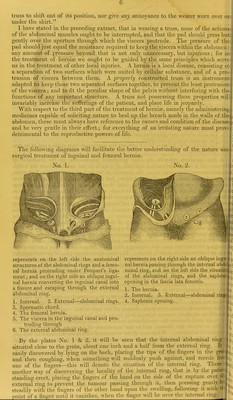
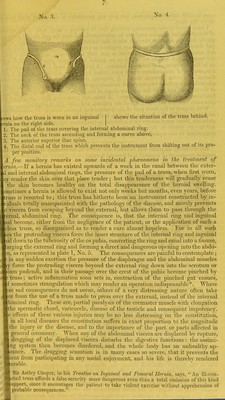
![6 luto the abdomen : after this, grasp the tumour, make a gentle but steady pressure upwards, and the protruding viscera will forthwith slip back into the abdomen. If ;his operation prove ineffectual, the sooner the assistance of a surgeon is procured, ,he better, as through delay the patient's life may be i)Iaced in jeopardy. If the case be a femoral hernia, the patient should place herself in the position re- 'ommended for reducing a scrotal hernia, to extend the pectinalis muscle below the •rural arch and behind the falciform process of the fascia lata, and to form a depres- lion in the upper and inner part of the thigh close to the groin, having the sartorius ind rectus fetnoris externally, the gracilis and adductor longus internally, with the )ectinahs and adductor brevis behind; then softly squeeze the tumour to force the luid contents into the abdomen : after this, press the tumour with the thumbs gently ■own towards the saphenic opening* in the fascia lata, whilst the tips of the fingers Ire cautiously urging the protruding viscera through that opening in the direction of lie femoral ring, i. e. backwards and upwards until they disappear. I The mode of returning an umbilical hernia need not be described here on account If its simplicity. I With respect to the second operation of the treatment, namely the bringing and lermanently keeping together the surfaces of the internal abdominal ring, I will fcpeat here what I have ah-eady published in the ' Lancet,' July 4, 1846, upon nis subject:— About twelve years ago my attention was directed to the various ■nds of trusses then recommended and used in the treatment of inguinal hei'nia. Wter a minute examination, I perceived that all these instruments were formed ■thout any reference to the anatomical structure of the parts affected—that the pad ■ every truss could only press upon the external abdominal ring; consequently could mt prevent the viscera from passing through the internal ring and lodging in the ■nal between the two rings, to the imminent danger of the wearerf. I hkewise Krceived, that when strong pressure of the pad was required to prevent the viscera mm escaping beyond the external ring, the circulation of the spermatic chord would ft interrupted, and thereby cause great injury to the patient J. To jirevent such ■ects, I constructed a truss upon a principle totally different from all others; and fcan now state that nearly one hunrlred § persons, males and females, are wearing m' invention, without having the least protrusion of the viscera, or the functions of ■y structure interrupted. I'It is difficult to give a correct descrijjtion of the ti'uss, ivhich I now strongly re- Mnmend to the notice of the numerous professional readers of the ' Lancet.' The w, which is about the size and shape of the point of a man's thumb, presses gently Kr and a little below the intemal abdominal ring, to enable the fibres of the trans- Msahs muscle which cross the outer part of the ring to sustain their tone, and the mer structure of the ring and inguinal canal their integrity. From the pad the ■ing of the truss ascends obliquely towards the spine of the ilium, forms a curve ■)ve the crista ilii, passes across the back, then descends and terminates in the op- Site groin. The pressure of the truss is confined chiefly to the pad and curves of M hoop : but care is requisite in fitting the truss to the part where the pressure of B pad must be made, else the instrument will be of no use to the wearer. As the bones of each person have something ])ecuhar, I make it a rule, vi'hen •lied to for a truss, first to ascertain the natm-e and condition of the hernia, and Make with the utmost correctness, the size and shape of the pelvis. After this I fthe truss to the patient, and test its capabihties under various circumstances before iBive it finished. S None of the actions of the abdominal muscles should be interrupted by the use of ■ truss; very little pressure of the pad is required to retain the viscera within the •omen; the effect ])roduced by a slight pressure of a finger over the internal ab- ■linal ring will convince any ruptured person of this. Nor ought a properly fitted <H This opening is situated about an inch and a half below the groin. See plate 2. No. 4. (B I have recently attended two cases of this kind, one exhibiting symptoms of inflammation', ■other of strangulation. 1 succeeded in relieving each patient by dilating the external • with the point of tlic little finger, and thus removing the spasmodic stricture at the flual ring, when the tumour disa])peared. ■ Of several hundred persons that have come under ray notice, and had worn trusses ■tructed to press upon tlie external abdominal ring, nine only were free from disease of jWperniatic chord or testicle. '■The numlKT amounts now to above two thousand, and in many cases the ruptured parts](https://iiif.wellcomecollection.org/image/b21483255_0007.jp2/full/800%2C/0/default.jpg)