A brief essay on the nature and treatment of herniae or ruptures : illustrated with engravings / by David Tod.
- Tod, David
- Date:
- 1851
Licence: Public Domain Mark
Credit: A brief essay on the nature and treatment of herniae or ruptures : illustrated with engravings / by David Tod. Source: Wellcome Collection.
Provider: This material has been provided by The University of Glasgow Library. The original may be consulted at The University of Glasgow Library.
8/12 (page 6)
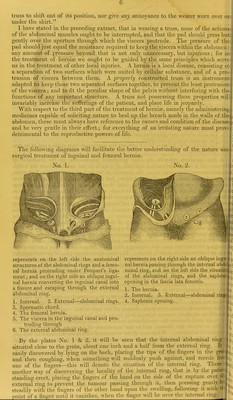
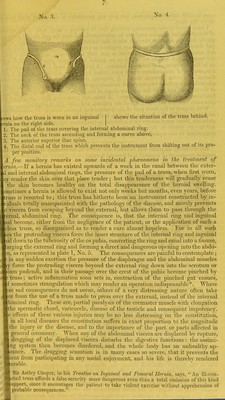
![truss to shift out of its position, nor give any annoyance to the wearer worn over or under the shirt. I have stated in the preceding extract, that in wearing a truss, none of the actions of the abdominal muscles ought to be interrupted, and that the pad should press but gently over the aperture through which the viscera protrude. The pressure of the pad should just equal the resistance required to keep the viscera within the abdomen; any amount of pressure beyond that is not only unnecessary, but injurious; for ir the ti-eatmeut of hernia; we ought to be guided by the same principles which serve us in the treatment of other local injuries. A hernia is a local disease, consisting ol a separation of two siu-faces which were united by cellular substance, and of a pro- trusion of viscera between them. A properly constructed truss is an instrumeni adapted to keep those two separated surfaces together, to prevent the least protrusior of the viscera; and to fit the peculiar shape of the pelvis without interfering with the functions of any important structure. A truss not possessing these properties wil invariably increase the sufferings of the patient, and place life in jeopai-dy. With respect to the third part of the treatment of heniia;, namely the administering medicines capable of soliciting nature to heal up the breach made in the walls of tht abdomen, these must always have reference to the causes and condition of the diseasfe and be very gentle in their effect; for everything of an irritating nature must provi' detrimental to the reproductive powers of life. The following diagrams will facilitate the better understanding of the natiu-e anc j surgical treatment of inguinal and femoral herniae. | No. 1. No. 2 represents on the right side an oblique ingm nal hernia passing tbrough the internal ab^ ,i minal ring, and on the left side the situalj of the abdominal rings, and the saphei I . opening in the fascia lata femoris. The hernia. Internal. 3. External—abdominal rinf Saphenic opening. represents on the left side the anatomical structures of the abdominal rings and a femo- ral hernia protruding under Poupart's liga- ment ; and on the right side an obHqne ingui- nal hernia converting the inguinal canal into a fissure and escaping through the external i abdominal ring. 2. 1. Internal. 2. External—abdominal rings. 4. 3. Spermatic chord. i 4. The femoral hernia. ; 5. The viscera in the inguinal canal and pro- ,, truding through j 6. The external abdominal ring. By the plates No. 1 & 2, it will be seen that the internal abdominal ring*: situated close to the groin, about one inch and a half from the external ring. It*' easilv discovered by lying on the back, placing the ti])s of the fingers in the grtSi^ and then coughing, when something will suddenly push against, and recede frcfr.^ one of the fingers—this will denote the situation of tlic internal ring. There'' another way of discovering the locality of the iuternal ring, that is by the patiao standing erect, placing the fingers of the liand on tlie side of the rupture over tl external ring to prevent the tumour passing througli it, then i)ressiug ge-.uily bi steadily with the fingers of the other iiand ujion the swelling, following it witli w' Doint of 11 finder uiil d it vsmishes, when tlio fingor will bo over the iuternal ring.](https://iiif.wellcomecollection.org/image/b21483255_0008.jp2/full/800%2C/0/default.jpg)