[Report 1918] / Medical Officer of Health, Accrington Borough.
- Accrington (England). Borough Council.
- Date:
- 1918
Licence: Attribution 4.0 International (CC BY 4.0)
Credit: [Report 1918] / Medical Officer of Health, Accrington Borough. Source: Wellcome Collection.
32/34 page 30
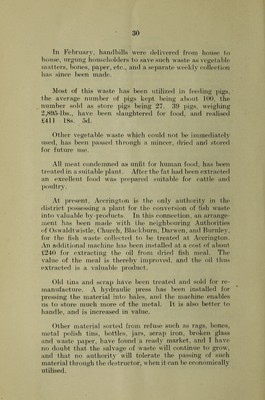
![Tn February, handbills were delivered from house to house, urgimg householders to save such waste as vegetable matters, bones, ])aper, etc., and a se])ai‘ate weekly collection has since been made. Most of this waste has been utilized in feeding pigs, ’ the average number of pigs kept being about 100, the number sold as store pigs being 27. 39 pigs, weighing 2,S95-lbs., have been slaughtered for food, and realised £411 18s. od. Other vegetable waste which could not be immediately used, has been passed through a mincer, di-ied and stored foT‘ future use. All meat condemned as unfit for human food, has been treated in a suitable plant. After the fat had been extracted an excellent food was pi‘e]^ared suitable for cattle and ])oultrv. At present, Accrington is the only authority in the district possessing a ]3lant tor the conversion of fish waste* into valuable by-products. In this connection, an arrange- ment has been made with tlie neighbouring Authoiities of Oswaldtwistle, Church, Blackburn, Dai wen, and Burnley, fo7‘ the fish waste collected to be treated at Accrington. An additional machine has been installed at a cost of about £240 for extracting the oil from dried fish meal. The value of the meal is thereby improved, and the oil thus, extracted is a valuable ]noduct. Old tins and scrap have been treated and sold for re- manufacture. A hydraulic press has been installed for ])ressing the material into bales, and the machine enables us to store much more of the metal. It is also better to handle, and is increased in value. Other material sorted from refuse such as rags, bones, metal polish tins, bottles, jars, scrap iron, broken glass and waste ])aper, have found a ready market, and I have no doubt that the salvage of waste will continue to grow, and that no authority will tolerate the passing of such material through the destructor, w hen it can b(^ economically utilised.](https://iiif.wellcomecollection.org/image/b28796652_0032.jp2/full/800%2C/0/default.jpg)
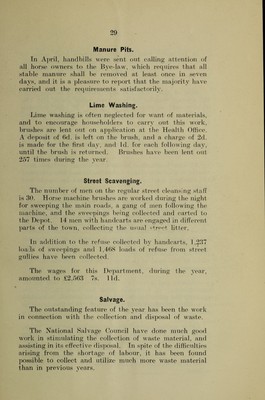
 No text description is available for this image
 No text description is available for this image
 No text description is available for this image