Diseases of the intestines and peritoneum / by Hermann Nothnagel ; edited, with additions by Humphrey D. Rolleston ; authorized translation from the German, under the editorial supervision of Alfred Stengel.
- Hermann Nothnagel
- Date:
- 1904
Licence: Public Domain Mark
Credit: Diseases of the intestines and peritoneum / by Hermann Nothnagel ; edited, with additions by Humphrey D. Rolleston ; authorized translation from the German, under the editorial supervision of Alfred Stengel. Source: Wellcome Collection.
Provider: This material has been provided by the Francis A. Countway Library of Medicine, through the Medical Heritage Library. The original may be consulted at the Francis A. Countway Library of Medicine, Harvard Medical School.
31/1106 page 23
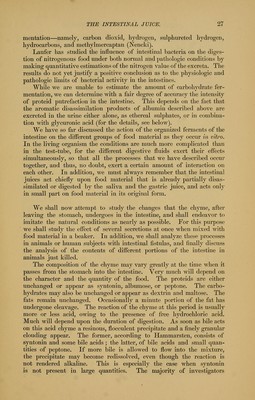
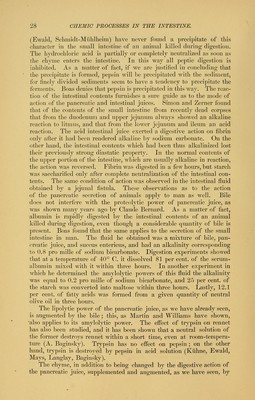
![which is identical with the ptyaliu-zyniogeu of the pancreas. [Rach- ford found that bile itself had some slight diastutic action, but that its chief effect on the digestion of carbohydrates was in helping the j^ancreatic juice—viz., in neutralizing free acid and in diminishing the retarding influence which bicarbonate of soda has upon the diastatic power of the pancreas.—Ed.] Hammarsten's quantitative analysis of the bile yielded the follow- ing figures : Solids 1.620- 3.520 Water 96.470-98.370 Mucin and piojments 0.270-0.910 Alkaline salts'of the bile acids 0.260- 1.820 Taurocholates 0.053- 0.303 Glycocholates 0.204- 1.610 Fatty acids (from soaps) 0.024- 0.136 Cholesterin , 0.048- 0.160 Lecithin 0.048- 0.065 Fat 0.061- 0.095 Soluble salts 0.676- 0.887 Insoluble salts 0.020- 0.049 As has been pointed out, experiments in vitro show that bile exer- cises no chemic effect on proteids and fats. It also appears that the effect of the bile on carbohydrates is infinitesimal as compared with the effect of an equal quantity of pancreatic juice. Another method of studying the influence of the bile on digestion is by chemic examination of the intestinal contents in the subjects of biliary fistula, in whom no bile passes into the bowel. The problem has been worked out by a number of investigators, with the following results : Rohmann, von Voit, and J. Munk found that albumin, gelatin, and carbohydrates are ab- sorbed from the intestine in a perfectly normal manner in the absence of the bile. The normal absorption of fat, however, is interfered with. A healthy animal was found to absorb nearly 99 per cent, of 150 to 200 grams of fat given by the mouth, and to pass only 1 per cent, of the fat in the feces. With a biliary fistula, more than 60 per cent, of the fat was passed in the stools (Voit). More than 150 grams were not tolerated at all. Munk^s experiments showed a rather higher absorp- tion of fat. He administered 247.6 grams of fat (lard) and 56.5 grams of nitrogen (albuminous diet), and found that 66.9 per cent, of the fat and 90 per cent, of the nitrogen were absorbed. The composition of the fat was the following : Neutral fat, 7.85 per cent.; free fatty acids, 61.84 per cent.; fatty acids,—as soaps,—10.93 per cent.; and choles- terin, 1.43 per cent. This shows that only one-tenth of the fats passed in the stools was neutral fat, and that a large proportion of free fatty acids was excreted (Rohmann, H4don, and Ville arrived at similar results). Voit, on the other hand, found that the fat in the feces was mainly unconverted. In animals with a biliary fistula symptoms of inanition usually appear, and must be considered as the result of defi- cient absorption of fat. Inanition can be prevented by a carefully arranged course of food.](https://iiif.wellcomecollection.org/image/b21170010_0031.jp2/full/800%2C/0/default.jpg)