Diseases of the intestines and peritoneum / by Hermann Nothnagel ; edited, with additions by Humphrey D. Rolleston ; authorized translation from the German, under the editorial supervision of Alfred Stengel.
- Hermann Nothnagel
- Date:
- 1904
Licence: Public Domain Mark
Credit: Diseases of the intestines and peritoneum / by Hermann Nothnagel ; edited, with additions by Humphrey D. Rolleston ; authorized translation from the German, under the editorial supervision of Alfred Stengel. Source: Wellcome Collection.
Provider: This material has been provided by the Francis A. Countway Library of Medicine, through the Medical Heritage Library. The original may be consulted at the Francis A. Countway Library of Medicine, Harvard Medical School.
38/1106 page 30
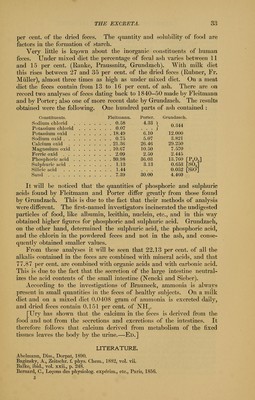
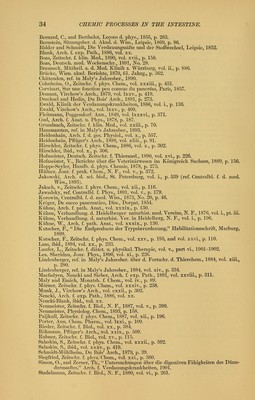
![mercaptan, could be detected eveu when a kilogram of the chyme was analyzed. Phenylpropionic acid, paraoxyphenylpropionic acid, and skatolacetic acid were also absent. An analysis of the ash of the con- tents of the small intestine showed that from 20 to 40 per cent, of the bases were combined with mineral acids; 60 to 80 per cent., with organic acids. [In a series of experiments on herbivora and carnivora Moore and Rockwood found that in herbivora the contents of the small intestine are more alkaline than in carnivora. Carbohydrate food increases the alkalinity of the small intestine, which it certainly would not do if attacked by bacteria and decomposed into organic acids. When the chyme reaches the cecum, it becomes acid from bacterial fermentation. From analogy the authors conclude that the human small intestine, which in reaction probably is intermediate between that of the herbivora and the carnivora, cannot, under normal conditions, have an acid reaction in any considerable part of its extent. They consider the three observations on human fistulas (Ewald's, Macfadyen, Nencki and Sieber's, Jakowski's) too small to form a decision on, and suggest that there may have been excessive bacterial activity in the small intestine.—Ed.] As soon as the intestinal contents passed from the small intestine into the colon a completely different chemic picture was presented : the reaction became alkaline, the action of the enzymes stopped, and the ordinary fecal odor appeared, showing that putrid fermentation of pro- teid material had begun. The exact composition of the contents of the colon was determined by M. Jakowski, who studied the intestinal con- tents obtained from a fistula situated in the ascending colon. From 150 to 200 grams of fecal intestinal contents of a doughy consistence and of a neutral or alkaline reaction were passed daily. There was 6.3 per cent, of dry residue, one-seventh of which consisted of mineral material. Neither unconverted bile-pigment nor bile acids could be discovered. Urobilin, skatol, phenol, traces of oxy-acids, ammonia, leucin, cadaverin, capronic acid, valerianic acid, succinic acid, lactic acid, ethyl alcohol, butyl alcohol, sulphureted hydrogen, and methyl- mercaptan were all present. Nencki, by his investigations, quoted above, was the first to estimate the amount of albumin which normally enters the large intestine. He calculated the nitrogen of the food, on the one hand, and of the chyme obtained from the fistula, on the other. The food contained 70.74 grams of proteid and 10.602 grams of nitrogen ; while the fluid passed in twenty-four hours from the fistula contained 26.5 grams of solid mate- rial, containing 1.61 grams of nitrogen in 10.06 grams of proteid. These figures show that only one-seventh of the food proteid, or, to be more accurate, 14.25 per cent., remained to be digested and assimilated in the large intestine, since 85.75 per cent, had been absorbed in the stomach and small intestine. The activity of the putrefactive processes depends on a variety of factors. In the first place, the amount of material available for putre- faction, represented chiefly by the proteids, exercises an influence on the](https://iiif.wellcomecollection.org/image/b21170010_0038.jp2/full/800%2C/0/default.jpg)