Diseases of the intestines and peritoneum / by Hermann Nothnagel ; edited, with additions by Humphrey D. Rolleston ; authorized translation from the German, under the editorial supervision of Alfred Stengel.
- Hermann Nothnagel
- Date:
- 1904
Licence: Public Domain Mark
Credit: Diseases of the intestines and peritoneum / by Hermann Nothnagel ; edited, with additions by Humphrey D. Rolleston ; authorized translation from the German, under the editorial supervision of Alfred Stengel. Source: Wellcome Collection.
Provider: This material has been provided by the Francis A. Countway Library of Medicine, through the Medical Heritage Library. The original may be consulted at the Francis A. Countway Library of Medicine, Harvard Medical School.
39/1106 page 31
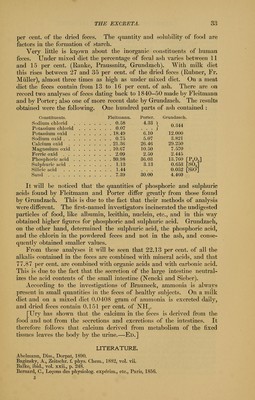
![intensity of the process. The quantity of protcid material present is, of course, primarily dependent on the amount ingested, and secondarily on the amount that is assimilated. Other factors that influence putre- faction are the length of time the material remains in the intestine, ^vhich again is dependent on the activity of the peristaltic movements of the intestine. Lastly, the reaction of the intestinal contents is of some importance. If markedly acid, especially if due to the presence of free acids, putrefaction is inhibited. Reference should be made to the re- marks on the antiseptic powers of the bile (vide p. 24). Hirschler has recently shown that the carbohydrates of the food seem to inhibit putrefaction to a certain extent. Laas studied the same problem and made out that the fats do not exercise the same inhibitory influence on putrefaction as the carbohydrates. Nencki and Blank have shown that putrefactive organisms have very little power to decompose fat. J. Wortmann's work on the carbohydrates shows that starch is acted upon by putrefying infusions of beans and potatoes in the same man- ner as by diastase. It appears, however, that this occurs only in the absence of other carbon compounds and in the presence of plenty of air. If putrefaction is allowed to continue for some time, the carbohydrates are completely converted into lactic, butyric, acetic, and carbonic acids and hydrogen. [B. Moore and Rockwood's experiments, already referred to, indicated that very little bacterial fermentation of carbohydrates took place in the small intestine of animals.—Ed.] The Hxcreta.—The excreta leaving the rectum consist partly of undigested or indigestible constituents of the food, and partly of more or less changed digestive fluids and bacteria. According to Rieder and Eubner, a diet limited to eggs and meat gives rise to feces consisting of intestinal secretions, as is the case during fasting. The consistence of the feces is determined by the proportion of the solid to the liquid constituents. The liquid portions are almost exclu- sively water. Under normal conditions, therefore, the consistence of the feces is doughy or pultaceous. The quantity of solid matter varies with the character of the diet (Pettenkofer and Voit). On a mixed diet, 120 to 150 grams, containing from 30 to 37 grams of solid residue, are excreted in twenty-four hours. Rubner found that 2438 grams of milk were represented by 96 grams of fresh feces, leaving a dry residue of 24.8 grams. With 1435 grams of meat, 64 grams of fresh feces, containing 17.2 grams of dry residue, were passed. If the diet con- sists largely of vegetable material, the quantity of feces increases con- siderably, as will be seen by the following table: 1360 grams of black bread yield 815 grams of fresh feces, 115.8 grams of dried feces. 3078 potatoes ' 635 93.8 3831 cabbage 1670 73.8 With a mixed diet the color of the feces is a dark brown (urobilin) ; if much meat is eaten, it is brownish black (hematin, sulphid of iron) ;](https://iiif.wellcomecollection.org/image/b21170010_0039.jp2/full/800%2C/0/default.jpg)