Diseases of the intestines and peritoneum / by Hermann Nothnagel ; edited, with additions by Humphrey D. Rolleston ; authorized translation from the German, under the editorial supervision of Alfred Stengel.
- Hermann Nothnagel
- Date:
- 1904
Licence: Public Domain Mark
Credit: Diseases of the intestines and peritoneum / by Hermann Nothnagel ; edited, with additions by Humphrey D. Rolleston ; authorized translation from the German, under the editorial supervision of Alfred Stengel. Source: Wellcome Collection.
Provider: This material has been provided by the Francis A. Countway Library of Medicine, through the Medical Heritage Library. The original may be consulted at the Francis A. Countway Library of Medicine, Harvard Medical School.
40/1106 page 32
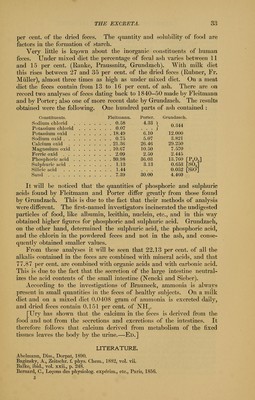
![on a milk diet it turns light yellow (owing to the large quantity of fat in the feces). The characteristic fecal odor is produced chiefly by skatol and volatile fatty acids. The reaction of the feces is usually slightly alkaline or neutral; less frequently slightly acid (Nothnagel). Qualitative analyses of the feces show the following constituents : Water, traces of albumin, mucin, various fats, occasionally cholalic acid, dyslysin, cholesterin, koprosterin, lecithin, skatol, indol, salts of the vola- tile fatty acids (especially butyric and acetic acids) and of lactic acid ; also calcium and magnesium soaps. Von Jaksch succeeded in demon- strating the presence of two ferments in human feces—one invertin, the other diastatic. [Hemmeter, in the sterile extract of human feces, the action of bacteria being thus excluded, found a proteolytic ferment acting best in an alkaline medium.—Ed.] The following inorganic salts are found in the feces : chlorids and carbonates of alkaline bases, earthy phosphates, and small quantities of iron salts and silicates. The quantitative composition of the feces depends largely on the diet and the digestive powers of the individual, and consequently varies greatly. The amount of nitrogen present in the stools of fasting per- sons is about 0.2 gram (this was found to be the case by Miiller in the stools of Cetti). If the diet contains no nitrogen, the amount of nitrogen excreted in the feces is somewhat larger, owing to the fact that a more abundant secretion of digestive fluids occurs in a diet of this character (Rieder). The amount of nitrogen fluctuates between 0.5 and 0.8 gram, or 4.1 to 5.8 per cent., of the dried feces. [Ury has investigated the point as to how much of the nitrogen normally found in the feces is derived from food and how much from intestinal secretions and excretions. The amount of nitrogen derived from the secretions and excretions of the intestines constitutes from 18 per cent, to 32 per cent, of the total nitrogen of the feces, which corresponds fairly well with Rieder's estimate of the amount of nitrogen found in the feces when food free of nitrogen is taken.—Ed.] When 884 gm. of meat per day were taken, 1.2 gm. N were ex- creted = 6.9 per cent, of the dried feces (Rubner). With a milk diet, 1.1 gm. N = 4 per cent, were excreted. A diet containing little feces- producing matter showed a daily excretion of 1.14 gm. N (Praussnitz). A vegetable diet (rich in feces-producing matter) raises the N-contents to 3J-4 per cent. (Voit, Rumpf, and Schumm). Under normal conditions the quantity of fat contained in the feces is independent of diet and excretions. The quantity of fat elaborated by the latter is determined by examination of the feces of fasting per- sons. These showed 1 gm. of fat a day. Both the quality and the quantity of the diet are to be considered. However, persons on the same diet have shown individual diiferences in fat-excretion. Carbohydrates give rise to but little starch. Sugar cannot be demon- strated at all. Schmidt and Strassburger demonstrated its presence under normal conditions after a test-meal to the amount of 2.3 and 4.8](https://iiif.wellcomecollection.org/image/b21170010_0040.jp2/full/800%2C/0/default.jpg)