The Community patent and the patent system in Europe, with evidence / House of Lords, Select committee on the European Communities.
- Great Britain. Parliment. House of Lords. Select Committee on the European Communities.
- Date:
- 1998
Licence: Open Government Licence
Credit: The Community patent and the patent system in Europe, with evidence / House of Lords, Select committee on the European Communities. Source: Wellcome Collection.
35/144 page 3
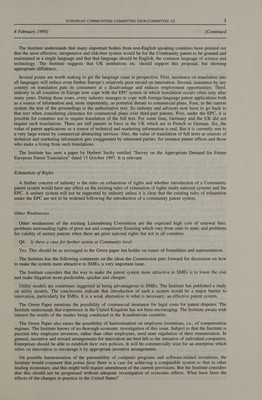
![4 February 1998] [Continued The Institute understands that many important bodies from non-English speaking countries have pointed out that the most effective, inexpensive and risk-free system would be for the Community patent to be granted and maintained in a single language and that that language should be English, the common language of science and technology. The Institute suggests that UK institutions etc. should support this proposal, but showing appropriate diffidence. Several points are worth making to get the language issue in perspective. First, insistence on translation into all languages will reduce even further Europe’s relatively poor record on innovation. Second, insistence by any country on translation puts its consumers at a disadvantage and reduces employment opportunities. Third, industry in all countries in Europe now cope with the EPC system in which translation occurs often only after many years. During those years, every industry manages to cope with foreign-language patent applications both as a source of information and, more importantly, as potential threats to commercial plans. Four, in the current system the text of the proceedings is the authoritative text. So industry and advisors now have to go back to that text when considering clearance for commercial plans over third-part patents. Five, under the EPC, it is possible for countries not to require translation of the full text. For some time, Germany and the UK did not require such translations. There are still patents in force in the UK which are in French or German. Six, the value of patent applications as a source of technical and marketing information is real. But it is currently met to a very large extent by commercial abstracting services. Also, the value of translation of full texts as sources of technical and marketing information gets exaggerated by interested parties, for instance patent offices and those who make a living from such translations. The Institute has seen a paper by Herbert Suchy entitled “Survey on the Appropriate Demand for Future European Patent Translation” dated 15 October 1997. It is relevant. Exhaustion of Rights A further concern of industry is the rules on exhaustion of rights and whether introduction of a Community patent system would have any effect on the existing rules of exhaustion of rights under national systems and the EPC. A unitary system will not be supported by industry unless it is clear that the existing rules of exhaustion under the EPC are not to be widened following the introduction of a community patent system. Other Weaknesses Other weaknesses of the existing Luxembourg Convention are the expected high cost of renewal fees; problems surrounding rights of prior use and compulsory licensing which vary from state to state; and problems for validity of unitary patents when there are prior national rights but not in all countries. Q6. Is there a case for further action at Community level. Yes. This should be as envisaged in the Green paper but bolder on issues of formalities and representation. The Institute has the following comments on the ideas the Commission puts forward for discussion on how to make the system more attractive to SMEs, a very important issue. The Institute considers that the way to make the patent system more attractive to SMEs is to lower the cost and make litigation more predictable, quicker and cheaper. Utility models are sometimes suggested as being advantageous to SMEs. The Institute has published a study on utility models. The conclusions indicate that introduction of such a system would be a major barrier to innovation, particularly for SMEs. It is a weak alternative to what is necessary: an effective patent system. The Green Paper mentions the possibility of commercial insurance for legal costs for patent disputes. The Institute understands that experience in the United Kingdom has not been encouraging. The Institute awaits with interest the results of the studies being conducted in the Scandinavian countries. The Green Paper also raises the possibility of harmonisation on employee inventions, i.e., of compensation regimes. The Institute knows of no thorough economic investigation of this issue. Subject to that the Institute is puzzled why employee inventors, rather than other employees, need state regulation of their remuneration. In general, incentive and reward arrangements for innovation are best left to the initiative of individual companies. Enterprises should be able to establish their own policies. It will be commercially wise for an enterprise which relies on innovation to encourage it by appropriate incentive arrangements. On possible harmonisation of the patentability of computer programs and software-related inventions, the Institute would comment that prima facie there is a case for achieving a comparable system to that in other leading economies, and this might well require amendment of the current provisions. But the Institute considers that this should not be progressed without adequate investigation of economic effects. What have been the effects of the changes in practice in the United States?](https://iiif.wellcomecollection.org/image/b32219568_0035.jp2/full/800%2C/0/default.jpg)



 No text description is available for this image
 No text description is available for this image
 No text description is available for this image