The Community patent and the patent system in Europe, with evidence / House of Lords, Select committee on the European Communities.
- Great Britain. Parliment. House of Lords. Select Committee on the European Communities.
- Date:
- 1998
Licence: Open Government Licence
Credit: The Community patent and the patent system in Europe, with evidence / House of Lords, Select committee on the European Communities. Source: Wellcome Collection.
53/144 page 21
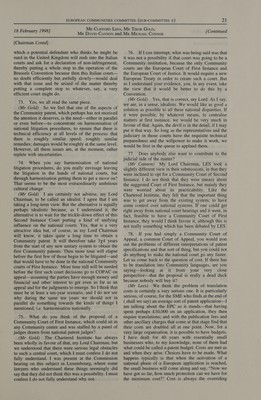
![[Chairman Contd] which a potential defendant who thinks he might be sued in the United Kingdom will rush into the Italian courts and ask for a declaration of non-infringement, thereby putting a whole stop to the operation of the Brussels Convention because then this Italian court— no doubt efficiently but awfully slowly—would deal with that issue and be seized of the matter thereby putting a complete stop to whatever, say, a very efficient court might do. 73. Yes, we all read the same piece. (Mr Gold) So we feel that one of the aspects of the Community patent, which perhaps has not received the attention it deserves, is the need—either in parallel or even before—to concentrate on harmonisation of national litigation procedures, to ensure that there is technical efficiency at all levels of the process: that there is roughly similar speed; roughly similar remedies; damages would be roughly at the same level. However, all these issues are, at the moment, rather replete with uncertainties. 74. When you say harmonisation of national litigation procedures, do you really envisage leaving the litigation in the hands of national courts, but through harmonisation getting them to get a move on? That seems to be the most extraordinarily ambitious cultural change. (Mr Gold) I am certainly not adverse, my Lord Chairman, to be called an idealist. I agree that I am taking a long-term view. But the alternative is equally perhaps idealistic because, as I understand it, the alternative is to wait for the trickle-down effect of this Second Instance Court putting a kind of unifying influence on the national courts. Yes, that is a very attractive idea but, of course, as my Lord Chairman will know, it takes quite a long time to obtain a Community patent. It will therefore take 3x4 years from the start of any new unitary system to obtain the first Community patents. Then more time will elapse before the first few of those begin to be litigated—and that would have to be done in the national Community courts of First Instance. More time still will be needed before the first such court decisions go to COPAC on appeal—assuming the parties have enough money and financial and other interest to get even as far as an appeal and for the judgments to emerge. So I think that must be at least a ten-year scenario, and I do not see why during the same ten years we should not in parallel do something towards the kinds of things I mentioned, i.e. harmonisation nationally. 75. What do you think of the proposal of a Community Court of First Instance, which could sit in any Community centre and was staffed by a panel of judges drawn from national patent judges? (Mr Gold) The Chartered Institute has always been wholly in favour of that, my Lord Chairman, but we understood that there were serious legal obstacles to such a central court, which I must confess I do not fully understand. I was present at the Commission hearing on this subject in Luxembourg, where some lawyers who understand these things seemingly did say that they did not think this was a possibility. I must confess I do not fully understand why not. 76. If I can interrupt, what was being said was that it was not a possibility if that court was going to be a Community institution, because the only Community courts are the European Court of First Instance and the European Court of Justice. It would require a new European Treaty in order to create such a court. But as I understand your evidence, you, in any event, take the view that it would be better to do this by a Convention. (Mr Gold) Yes, that is correct, my Lord. As I say, we are, in a sense, idealists. We would like as good a solution as possible to all these national disparities. If it were possible, by whatever means, to centralise matters at first instance, we would be very much in favour of that. Again, the devil is in the detail, if I may put it that way. So long as the representatives and the judiciary in those courts have the requisite technical preparedness and the willpower to make it work, we would be first in the queue to applaud them. 77. Does anybody else want to contribute to the judicial side of the matter? (Mr Cannon) My Lord Chairman, LES took a slightly different view in their submissions, in that they were inclined to opt for a Community Court of Second Instance. I do not think that they were uneasy about the suggested Court of First Instance, but mainly they were worried about its practicability. Like the Chartered Institute, they felt that the important thing was to get away from the existing system; to have some control over national systems. If one could get right away from national court hearings and it were, in fact, feasible to have a Community Court of First Instance, they would I think favour it, although this is not really something which has been debated by LES. 78. If you had simply a Community Court of Appeal, a common Court of Appeal, you would iron out the problems of different interpretations of patent specifications and that sort of thing, but you could not do anything to make the national court go any faster. Let us come back to the question of cost. If there has to be translation into Community languages, are you saying—looking at it from your very close perspective—that the proposal is really a dead duck because nobody will buy it? (Mr Lees) We think the problem of translation costs is certainly a very serious one. It is particularly serious, of course, for the SME who finds at the end of ( shall we say) an average sort of patent application—I am talking about the EPC as it stands—that having spent perhaps £10,000 on an application, they then require translations; and with the publication fees and other ancillary charges that come at that stage find that their costs are doubled all at one point. Now, for a very large organisation, it is possible to have budgets. I have dealt for 40 years with essentially small businesses who, to my knowledge, none of them had what could be called a patent budget. Costs are met as and when they arise. Choices have to be made. What happens typically is that when the activation of a national phase of a European application is reached, the small business will come along and say, “Now we have got so far, how much protection can we have for the minimum cost?” Cost is always the overriding](https://iiif.wellcomecollection.org/image/b32219568_0053.jp2/full/800%2C/0/default.jpg)




 No text description is available for this image
 No text description is available for this image
 No text description is available for this image