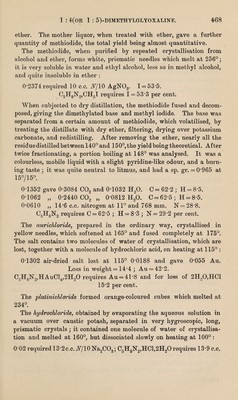
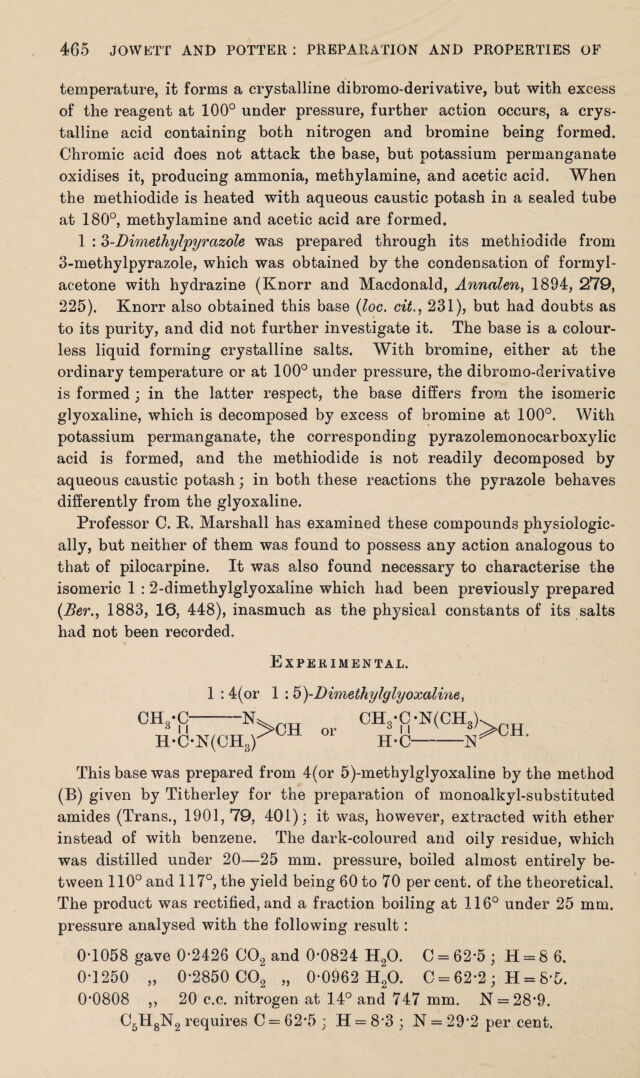
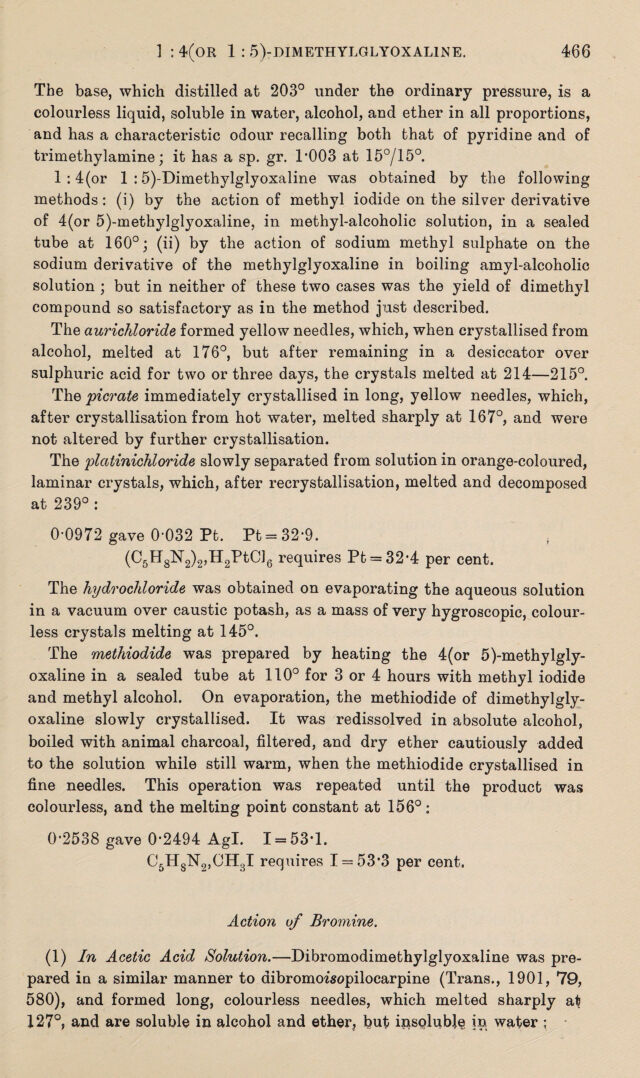
Preparation and properties of 1:4(or 1:5)-dimethylglyoxaline and 1:3-dimethylpyrazole / by Hooper Albert Dickinson Jowett and Charles Etty Potter.
- Jowett, H. A. D. (Hooper Albert Dickinson)
- Date:
- [between 1900 and 1909?]
Licence: In copyright
Credit: Preparation and properties of 1:4(or 1:5)-dimethylglyoxaline and 1:3-dimethylpyrazole / by Hooper Albert Dickinson Jowett and Charles Etty Potter. Source: Wellcome Collection.
6/8 page 469
![Action of Bromine. (1) In Acetic Acid Solution.—Dibromodimethylpyrazole, which was prepared in the same manner as the dibromodimethy]glyoxaline, formed long, white needles melting at 74°; these were very soluble in ethyl or methyl alcohol, and in ether or acetone, but insoluble in water : 0-2018 gave 0-3010 AgBr. Br = 63'4. ^'5H6'N2Br2 requires Br = 63 per cent. (2) In Aqueous Solution under Pressure.—This reaction was found to yield the same product as the previous one. Attempts to reduce the dibromodimethylpyrazole with zinc dust and glacial acetic acid, and also with sodium and boiling amyl alcohol, were unsuccessful. Oxidation with Potassium Permanganate. Dimethylpyrazole on oxidation with permanganate at 80° yielded no volatile base, but an acid forming colourless laminar crystals melt¬ ing at 222°. The crystals were moderately soluble in hot water, and almost insoluble in cold : 0-1266 gave 0-2208 C02 and 0-0554 H20. C = 47*6 ; H ^ 4*8. requires C = 47'6 ; H = 48 per cent. The product of oxidation was therefore A^metbylpyrazolemono- carboxylic acid CH-N(CH3)>n ’ CH-C(CO,H) Action of Caustic Potash under Pressure on the Methiodide. This experiment was carried out in the usual manner, but as the amount of volatile bases formed was so minute, it was evident that the reaction had not taken place so readily or so completely as was the case with the glyoxaline ; it was therefore not further investigated. 1 : 2-Dimethylglyoxaline, CJi This compound was prepared in a precisely similar manner to that given above for the preparation of 1 :4(or 1 :5)-dimethylglyoxaline, that is, by the action of the sodium derivative of 2-methylglyoxaline on sodium methyl sulphate. A fraction boiling at 205—206° was analysed with the following result.:](https://iiif.wellcomecollection.org/image/b30614491_0006.jp2/full/800%2C/0/default.jpg)