[Report 1958] / Medical Officer of Health, Dudley County Borough.
- Dudley (England). County Borough Council.
- Date:
- 1958
Licence: Attribution 4.0 International (CC BY 4.0)
Credit: [Report 1958] / Medical Officer of Health, Dudley County Borough. Source: Wellcome Collection.
57/72 page 54
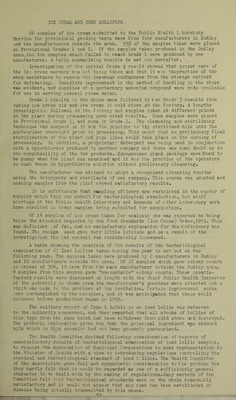
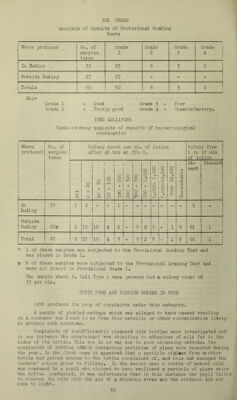
![ICE CREAJ,i AND ICED LOLLIPOPS 60 samples of ice cream submitted to the Public Health L.boratory Service for provisional grading tests were from four manufacturers in Dudley and ten manufacturers outside the area. 93^ of fhe samples taken were placed -in Provisional Grades 1 and 2. Of the samples taken produced in the Dudley area^the ten samples which failed to reach Grade 1 were produced by one manufacturer. A table suiimiarising results is set out hereafter. Investigation of the initial Grade 4 resi'lt showed that proper care of the ice cream servers was not being taken and that it was thepractice of the shop assistants to remove the icecream containers from the storage cabinet for defrosting. Immediate improvement in the method of handling in the shops was evident, and supplies of a quaternary ammonium compound were made available for use in serving utensil rinse water. Grade 1 resiilts in the shops were followed by t wo Grade 3 results from ageing ice cream mix and ice cream in cold store at the factory, A lengthy investigation followed at the factory and samples taken at different points in the plant during processing gave mixed results. Some samples -were placed in Provisional Grade 1, and some in Grade 2, The cleansing and sterilising technique was suspect as it was the practice to tip sterilised milk into the pasteuriser overnight prior to processing. This meant that no preliminary final sterilisation of the plant .and pipe lines could to,ke place on the morning of processing. In addition, a proprietary detergent was being used in conjimction with a hypochlorite produced by another company and there was some doubt as to the compatability of the two products. Homogeniser gland packings were foiond to be gummy when the plant Yms examined and it was the practice of the operators to ^-vash those in hypochlorite solution without preliminary cleansing. The manufacturer v;as advised to adopt a recognised cleansing routine using the detergents and sterilants of one company. This course was adopted and ensuing samples from, the plant showed satisfactory results. It is imfort-unate that sampling officers are restricted in the number of samples which they can submit for bacteriological examination, but staff shortag-e at the Public Health Laboratory and dem^ands of other laboratory ?/ork have resulted in fewer samples being submitted for examination. Of l6 samples of ice cream taken for analysis one was reported as being below the standai'd required by the Food Standards (ice Cream) Order,1953* This was deficient' of fat, and no satisfactory explanation for the deficiency was found. The recipe used gave very little latitude atid a,s a result of the investigation the fat content was considerably increased. A table showing the analysis, of the results of the bacteriological examination of 67 Iced Lollies taken during the year is set out on the following page. The samples taken were produced by 2 manufacturers in Dudley and 10 manufacturers outside the area. Of 22 samples which gave colony counts in excess of 300, 18 were from the same manufacturer outside the Dudley area. 8- samples from this soiurce gave uncountable colony counts. These unsatis- factory r esults were discussed at length with the Chief Public Health Inspector of the authority in whose area the manufacturer's premises were situated and a visit was made to the premises at liis invitation. Certain improvement works '.■ere contemplated by the occupier, and it was anticipated that these would cormence before production began in 1959* The solitary report of Type 1 B.Coli in an iced lollie was referred to the authority concerned, and they reported that all stocks of lo].lies of this type from the same batch had been withdra'wn from cold store and destroyed. The probable explanation given v;as that the principal ingredient v/as skimmed milk 7;hich on this occasion had not been properly pasteurised. The Health Committee decided following consideration of reports of ■unsatisfactory results of bacteriological examination of iced lollie samples, to request the Association of Municipal Corporations to make representation to the Minister of Health with a view to introducing regulations controlling the chemical and bacteriological standard of iced lollies. The Health Committee of the Association gave full and sympathetic consideration to t he problem but they hardly felt that it could be regarded as one of a sufficiently general character to be dealt with by the making of regulations.Many members of the Committee felt f'at bacteriological standards were on the whole reasonably satisfactory and it would not appe-ar that any case has been established of disease being actually transmitted bj'- this means, R/1 —](https://iiif.wellcomecollection.org/image/b29171234_0059.jp2/full/800%2C/0/default.jpg)