Volume 1
A text-book of experimental psychology : with laboratory exercises / by Charles S. Myers.
- Charles Samuel Myers
- Date:
- 1911
Licence: Public Domain Mark
Credit: A text-book of experimental psychology : with laboratory exercises / by Charles S. Myers. Source: Wellcome Collection.
118/370 page 96
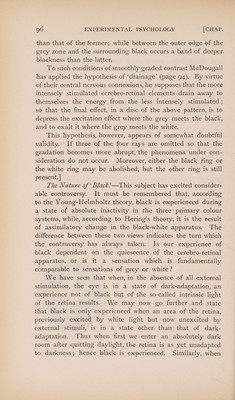
![than that of the former; while between the outer edge of the grey zone and the surrounding black occurs a band of deeper blackness than the latter. To such conditions of smoothly graded contrast McDougall has applied the hypothesis of ‘drainage’ (page 94). By virtue of their central nervous connexions, he supposes that the more intensely stimulated cerebro-retinal elements drain away to themselves the energy from the less intensely stimulated ; so that the final effect, in a disc of the above pattern, is to depress the excitation effect where the grey meets the black, and to exalt it where the grey meets the white. This hypothesis, however, appears of somewhat doubtful validity. If three of the four rays are omitted so that the gradation becomes more abrupt, the phenomena under con¬ sideration do not occur. Moreover, either the black ring or the white ring may be abolished, but the other ring is still present.] The Nature of'Black!—This subject has excited consider¬ able controversy. It must be remembered that, according to the Young-Helmholtz theory, black is experienced during a state of absolute inactivity in the three primary colour systems, while, according to Hering’s theory, it is the result of assimilatory change in the black-white apparatus. The difference between these two views indicates the turn which the controversy has always taken. Is our experience of black dependent on the quiescence of the cerebro-retinal apparatus, or is it a sensation which is fundamentally comparable to sensations of grey or white ? We have seen that when, in the absence of all external stimulation, the eye is in a state of dark-adaptation, an experience not of black but of the so-called intrinsic light of the retina results. We may now go further and state that black is only experienced when an area of the retina, previously excited by white light but now unexcited by external stimuli, is in a state other than that of dark- adaptation. Thus when first we enter an absolutely dark room after quitting daylight, the retina is as yet unadapted to darkness; hence black is experienced. Similarly, when](https://iiif.wellcomecollection.org/image/b3135984x_0001_0118.jp2/full/800%2C/0/default.jpg)