Volume 1
A text-book of experimental psychology : with laboratory exercises / by Charles S. Myers.
- Charles Samuel Myers
- Date:
- 1911
Licence: Public Domain Mark
Credit: A text-book of experimental psychology : with laboratory exercises / by Charles S. Myers. Source: Wellcome Collection.
141/370 page 119
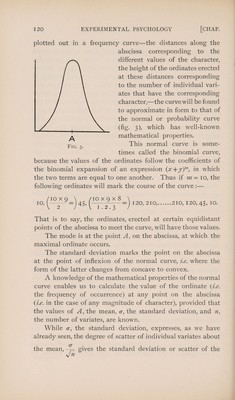
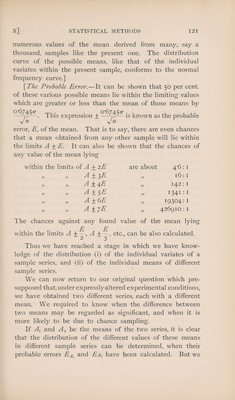
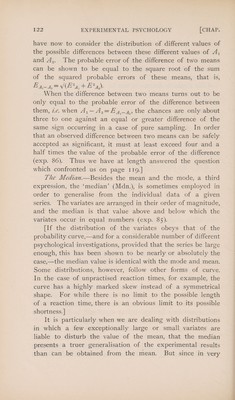
![to content ourselves in any scientific experiment, is only an approximation to the value obtained from a larger series. Different values of the mean would result from successive series of observations. In other words, the mean, experi¬ mentally obtained, is only the mean of a single sample of observations, different samples of which are certain to give somewhat different means. This fact becomes of enormous importance, when one set of experimental conditions produces a mean result, which differs from that obtained under another, purposely different, set of experimental conditions. The question then arises, is this difference between the means ‘ significant ’ or is it £ accidental,’—that is to say, does it really express the effect of the intentionally altered experi¬ mental conditions, or may it not after all be due to the chances of sampling above referred to ? To settle this question, we have to consider the probable distribution of such chance variations of the mean, say, in a thousand samples of observations, each sample consisting of, say, two hundred measurements, and obtained under conditions as constant as possible. Clearly, the values of the thousand different means will range about a single mean of the possible means. The greater number of values will occur at or near this point, and others will occur in diminishing number as we recede from it. If we assume (and in the absence of other information we have no alternative than to assume) that the single, experimentally obtained, mean is identical with the value of the mean of the thousand possible means, we are able to study the mode of distribution of the other means on either side of it, by having recourse to the properties of the ‘normal’ or ‘probability’ distribution curve of Gauss’s law of error.] [The Normal Curve.—In order to understand this appli¬ cation of the normal curve, let us suppose that a considerable number of measurements be made of a complex variable character, e.g. by determining the successive results of throwing heaps of coins or by determining the stature of unselected individuals within a given community. If now such a series of observations (or ‘ variates,’ as they are often called) be](https://iiif.wellcomecollection.org/image/b3135984x_0001_0141.jp2/full/800%2C/0/default.jpg)