Volume 1
A text-book of experimental psychology : with laboratory exercises / by Charles S. Myers.
- Charles Samuel Myers
- Date:
- 1911
Licence: Public Domain Mark
Credit: A text-book of experimental psychology : with laboratory exercises / by Charles S. Myers. Source: Wellcome Collection.
144/370 page 122
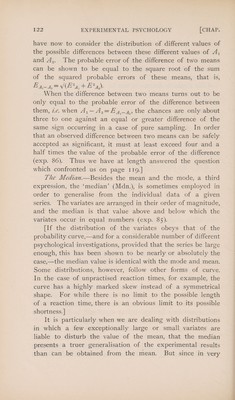
![have now to consider the distribution of different values of the possible differences between these different values of Ax and A2. The probable error of the difference of two means can be shown to be equal to the square root of the sum of the squared probable errors of these means, that is, Ea,-a2 — V(^2Tj + E'a,). When the difference between two means turns out to be only equal to the probable error of the difference between them, i.e. when A1 — A2 = the chances are only about three to one against an equal or greater difference of the same sign occurring in a case of pure sampling. In order that an observed difference between two means can be safely accepted as significant, it must at least exceed four and a half times the value of the probable error of the difference (exp. 86). Thus we have at length answered the question which confronted us on page 119.] The Median.—Besides the mean and the mode, a third expression, the 'median’ (Mdn.), is sometimes employed in order to generalise from the individual data of a given series. The variates are arranged in their order of magnitude, and the median is that value above and below which the variates occur in equal numbers (exp. 85). [If the distribution of the variates obeys that of the probability curve,—and for a considerable number of different psychological investigations, provided that the series be large enough, this has been shown to be nearly or absolutely the case,—the median value is identical with the mode and mean. Some distributions, however, follow other forms of curve. In the case of unpractised reaction times, for example, the curve has a highly marked skew instead of a symmetrical shape. For while there is no limit to the possible length of a reaction time, there is an obvious limit to its possible shortness.] It is particularly when we are dealing with distributions in which a few exceptionally large or small variates are liable to disturb the value of the mean, that the median presents a truer generalisation of the experimental results than can be obtained from the mean. But since in very](https://iiif.wellcomecollection.org/image/b3135984x_0001_0144.jp2/full/800%2C/0/default.jpg)