Volume 1
A text-book of experimental psychology : with laboratory exercises / by Charles S. Myers.
- Charles Samuel Myers
- Date:
- 1911
Licence: Public Domain Mark
Credit: A text-book of experimental psychology : with laboratory exercises / by Charles S. Myers. Source: Wellcome Collection.
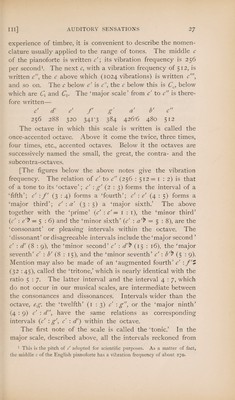
46/370 page 26
![Having reviewed the physical, we may pass on to the psychological relations between tone and noise. A discussion of their physiological relations will be deferred until we come to consider the general theories of hearing (page 52). It is often said that a noise is as different from a tone sensation as white is different from a colour sensation. Certainly, in their purest form, noise and tone are fundamentally different experiences. The one is unpleasant, rough, irregular, and difficult to analyse, the other is pleasant, smooth, regular, and relatively simple. It is clear that every gradation may occur between a sensation of noise and one of tone, eg. between the noise resulting from striking a tea-tray and the tone resulting from striking a bell. One reason for the possibility of this grada¬ tion lies in the fact that there are few noise stimuli that do not contain tone stimuli also. Tones of definite pitch may be detected in the roar of a waterfall or amid the hum of traffic in the heart of a busy city. Resonators will help in the identification of such tonal components of noises. But even a quite toneless noise is not devoid of pitch, although the latter can be estimated only vaguely. For after a little practice, we can definitely say that one noise is higher or lower than another, although we are unable to determine its precise pitch (exp. 20).] Timbre.—If nearly all noises contain tones, it is likewise true that the production of tones involves noise. It is im¬ possible to name an instrument which can emit a noiseless tone. In the horn noise arises from blowing, in the piano from striking, in the harp from plucking, and in the violin from bowing the instrument. Now it is obvious that the sounds of these several instru¬ ments differ from one another, apart from their specific accompanying noises. A tone of a given pitch on the bassoon is not to be mistaken for a tone of the same pitch on the piano or on the violoncello. The difference does not lie in noise, pitch, or loudness, but in a quality which we call ‘ timbre ’ (exp. 21). Tone Nomenclature.—Before we examine the basis of this](https://iiif.wellcomecollection.org/image/b3135984x_0001_0046.jp2/full/800%2C/0/default.jpg)