Volume 1
A text-book of experimental psychology : with laboratory exercises / by Charles S. Myers.
- Charles Samuel Myers
- Date:
- 1911
Licence: Public Domain Mark
Credit: A text-book of experimental psychology : with laboratory exercises / by Charles S. Myers. Source: Wellcome Collection.
53/370 page 33
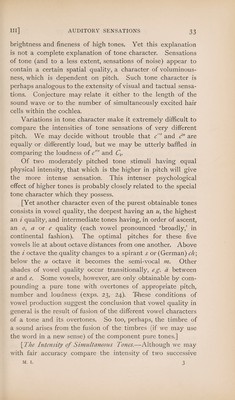
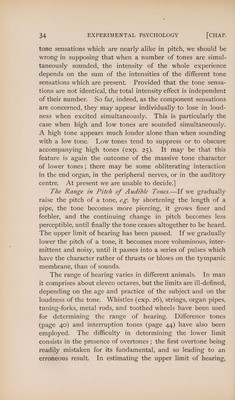
![brightness and fineness of high tones. Yet this explanation is not a complete explanation of tone character. Sensations of tone (and to a less extent, sensations of noise) appear to contain a certain spatial quality, a character of voluminous¬ ness, which is dependent on pitch. Such tone character is perhaps analogous to the extensity of visual and tactual sensa¬ tions. Conjecture may relate it either to the length of the sound wave or to the number of simultaneously excited hair cells within the cochlea. Variations in tone character make it extremely difficult to compare the intensities of tone sensations of very different pitch. We may decide without trouble that c' and eiv are equally or differently loud, but we may be utterly baffled in comparing the loudness of o' and £j. Of two moderately pitched tone stimuli having equal physical intensity, that which is the higher in pitch will give the more intense sensation. This intenser psychological effect of higher tones is probably closely related to the special tone character which they possess. [Yet another character even of the purest obtainable tones consists in vowel quality, the deepest having an u, the highest an i quality, and intermediate tones having, in order of ascent, an o, a or e quality (each vowel pronounced ‘broadly,’ in continental fashion). The optimal pitches for these five vowels lie at about octave distances from one another. Above the i octave the quality changes to a spirant j or (German) ch\ below the u octave it becomes the semi-vocal m. Other shades of vowel quality occur transitionally, eg. a between a and e. Some vowels, however, are only obtainable by com¬ pounding a pure tone with overtones of appropriate pitch, number and loudness (exps. 23, 24). These conditions of vowel production suggest the conclusion that vowel quality in general is the result of fusion of the different vowel characters of a tone and its overtones. So too, perhaps, the timbre of a sound arises from the fusion of the timbres (if we may use the word in a new sense) of the component pure tones.] [IVie Intensity of Simultaneous Tones.—Although we may with fair accuracy compare the intensity of two successive m. 1. 3](https://iiif.wellcomecollection.org/image/b3135984x_0001_0053.jp2/full/800%2C/0/default.jpg)