Volume 1
A text-book of experimental psychology : with laboratory exercises / by Charles S. Myers.
- Charles Samuel Myers
- Date:
- 1911
Licence: Public Domain Mark
Credit: A text-book of experimental psychology : with laboratory exercises / by Charles S. Myers. Source: Wellcome Collection.
54/370 page 34
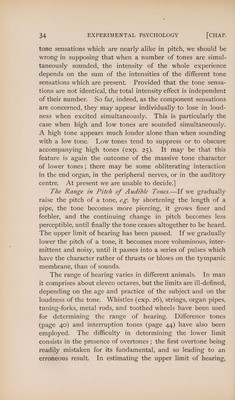
![tone sensations which are nearly alike in pitch, we should be wrong in supposing that when a number of tones are simul¬ taneously sounded, the intensity of the whole experience depends on the sum of the intensities of the different tone sensations which are present. Provided that the tone sensa¬ tions are not identical, the total intensity effect is independent of their number. So far, indeed, as the component sensations are concerned, they may appear individually to lose in loud¬ ness when excited simultaneously. This is particularly the case when high and low tones are sounded simultaneously. A high tone appears much louder alone than when sounding with a low tone. Low tones tend to suppress or to obscure accompanying high tones (exp. 25). It may be that this feature is again the outcome of the massive tone character of lower tones ; there may be some obliterating interaction in the end organ, in the peripheral nerves, or in the auditory centre. At present we are unable to decide.] The Range in Pitch of Audible Tones.—If we gradually raise the pitch of a tone, eg. by shortening the length of a pipe, the tone becomes more piercing, it grows finer and feebler, and the continuing change in pitch becomes less perceptible, until finally the tone ceases altogether to be heard. The upper limit of hearing has been passed. If we gradually lower the pitch of a tone, it becomes more voluminous, inter¬ mittent and noisy, until it passes into a series of pulses which have the character rather of thrusts or blows on the tympanic membrane, than of sounds. The range of hearing varies in different animals. In man it comprises about eleven octaves, but the limits are ill-defined, depending on the age and practice of the subject and on the loudness of the tone. Whistles (exp. 26), strings, organ pipes, tuning-forks, metal rods, and toothed wheels have been used for determining the range of hearing. Difference tones (page 40) and interruption tones (page 44) have also been employed. The difficulty in determining the lower limit consists in the presence of overtones ; the first overtone being readily mistaken for its fundamental, and so leading to an erroneous result. In estimating the upper limit of hearing,](https://iiif.wellcomecollection.org/image/b3135984x_0001_0054.jp2/full/800%2C/0/default.jpg)