Clinical manual for the study of medical cases / edited by James Finlayson.
- Date:
- 1886
Licence: Public Domain Mark
Credit: Clinical manual for the study of medical cases / edited by James Finlayson. Source: Wellcome Collection.
Provider: This material has been provided by the Augustus C. Long Health Sciences Library at Columbia University and Columbia University Libraries/Information Services, through the Medical Heritage Library. The original may be consulted at the the Augustus C. Long Health Sciences Library at Columbia University and Columbia University.
22/708 page 18
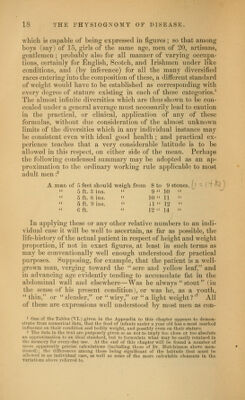
![which is capable of being expressed in figures; so that among boys (say) of 15, girls of the same age, men of 20, artisans, gentlemen; probably also for all manner of varying occupa- tions, certainly for English, Scotch, and Irishmen under like conditions, and (by inference) for all the many diversified races entering into the composition of these, a different standard of weight would have to be established as corresponding with every degree of stature existing in each of these categories.^ The almost infinite diversities which are thus shown to be con- cealed under a general average must necessarily lead to caution in the practical, or clinical, application of any of these formulas, without due consideration of the almost unknown limits of the diversities which in any individual instance may be consistent even with ideal good health ; and practical ex- perience teaches that a very considerable latitude is to be allowed in this respect, on either side of the mean. Perhaps the following condensed summary may be adoi)ted as an ap- proximation to the ordinary working rule applicable to most adult men -? A man of 5 feet should weigh from 8 to 9 stones. ' ■ - '■ i 4 ) 5 ft. 3 ins. 9 10 ^ ^ 5 ft. 6 ins. 10 11 5 ft. 9 ins. 11 12 '' G ft. 12 14 In applying these or any other relative numbers to an indi- vidual case it will be well to ascertain, as far as possible, the life-history of the actual 2:>atient in respect of height and weight proportion, if not in exact figures, at least in such terms as may be conventionally well enough understood for practical purposes. Supposing, for example, that the patient is a well- grown man, verging toward the sere and yellow leaf, and in advancing age evidently tending to accumulate fat in the abdominal wall and elsewhere—Was he always stout (in the sense of his present condition), or was he, as a youth, thin, or slender, or wiry, or a light weight ? All of these are expressions w^ell understood by most men as con- 1 One of the Tidilf^s (VI.) given in tlie Appendix to tliis chapter aijpearis to demou- Htrato from numerical data, that the food of infants under a year old lias a most marked influence on their condition and bodily weight, and possibly even on their stature. - The data in the text are purposely given so as not to imi)ly too close or too absolute an ai)i)roximation to an ideal standard, lait to funnuliite what may be easily retained in the memory f(jr every-day use. At the end of this chapter will lie found a n\imber of more ajfparently ]»recise calculations (including those of Dr. JIutchinson above men- tioned) ; the differences among these being significant of the latitude that must be allowed in an individual case, as well as some of the more calculable elemcuts in the variations above referred to.](https://iiif.wellcomecollection.org/image/b21222575_0022.jp2/full/800%2C/0/default.jpg)
 No text description is available for this image
 No text description is available for this image
 No text description is available for this image