Foods, their composition and analysis : a manual for the use of analytical chemists and others : with an introductory essay on the history of adulteration / by Alexander Wynter Blyth.
- Date:
- 1882
Licence: Public Domain Mark
Credit: Foods, their composition and analysis : a manual for the use of analytical chemists and others : with an introductory essay on the history of adulteration / by Alexander Wynter Blyth. Source: Wellcome Collection.
Provider: This material has been provided by the Royal College of Physicians of Edinburgh. The original may be consulted at the Royal College of Physicians of Edinburgh.
114/674 (page 80)
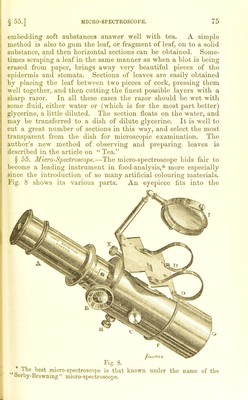
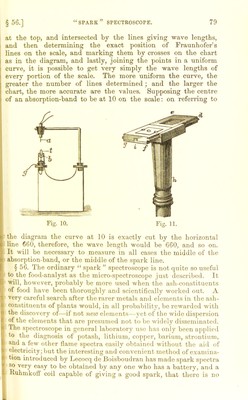
![reason, why an examination of the spark spectra of a body should not become the daily matter-of-course process in all laboratories, and not be restricted to pure scientific inquiry. Boisboudran’s method is simply to pass the spark through a solution of the substance to be examined, and for this purpose the following apparatus can be constructed out of the ordinary apparatus of the laboratory (fig. 10). A Woulfe’s bottle is fitted with two good India-rubber corks. In the one a stout glass rod is placed, bent at right angles, serving as a support for a glass tube, through which the wire of the negative pole projects ; the other neck carries a little test- tube with the wire g, which comes up through the cork, and J| the test-tube supports a still smaller one, capable of holding a very small quantity of the liquid to be examined; the wire is fused into the bottom of this tube, and terminates a little I below the mouth. Over the wire there is a minute tube, some- I what funnel-shaped at the end, which prevents the spark flying to the side of the test-tube ; in the larger tube there is a little 9 mercury to ensure contact. One effect of this arrangement is fl that the lower pole has always a thin film of the liquid over its jl surface, and on passing the current the spark volatilises the I substances in solution, and their characteristic spectra are easily V obseiwed. There are methods of quantitative spectrum analysis proposed ) by Vierordt and others; but, as yet, they are not sufficiently practical for general use, and the subject requires fresh develop- II ments. § 57. Photography.—The introduction of dry plates and the B general simplification of photography will, in a very little time, B make its practice general in all the larger laboratories for pur- poses of registration. In important analyses, likely to entail i evidence in the higher courts of justice, it might be useful (and ]| will always be possible) to photograph certain analytical results. In the quantitative determination of mixtures of starches, a ; micro-photograph of the mixed starch and the “ imitation ” mix- tures, renders the counting of the number of starches in the field a very easy operation. Similarly, if a measurement of any object be required, a micro-photograph having been taken, and next a photograph of the stage micrometer with the same powers, the n object may be measured more easily than in the ordinary way. ;i It is also most useful for the analyst to have by him, in this way, /w a series of “ picture records ” for reference. Stein’s photographic microscope,* when the object is not to make pretty pictures, nor is * Das Licht imDiemte wissenschaftlicher Forsckung. Von Dr. Th. Stein, 1 :* Leipzic, 1877.](https://iiif.wellcomecollection.org/image/b2190165x_0116.jp2/full/800%2C/0/default.jpg)