History of the ligature applied to the brachio-cephalic artery : with statistics of the operation : paper read before the Tennessee State Medical Society, May, 1856 / by Paul F. Eve.
- Paul F. Eve
- Date:
- 1856
Licence: Public Domain Mark
Credit: History of the ligature applied to the brachio-cephalic artery : with statistics of the operation : paper read before the Tennessee State Medical Society, May, 1856 / by Paul F. Eve. Source: Wellcome Collection.
Provider: This material has been provided by the National Library of Medicine (U.S.), through the Medical Heritage Library. The original may be consulted at the National Library of Medicine (U.S.)
14/30
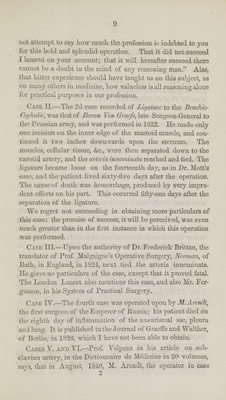
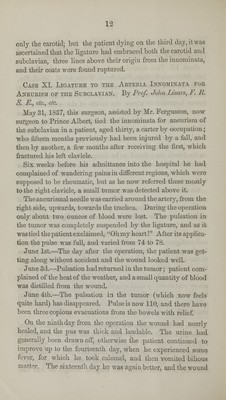
![fourth, verbally communicated to him that another distinguished surgeon of St. Petersburgh, M. Bujalsh] had twice performed the same operation, losing both patients at the end of two or three days.* Case VIL—This case is published in the Baltimore Medical and Surgical Journal and Review, volume I., and was operated upon by Prof. J. Wilmot Hall, M. R, on the 7th of September, 1830. Several diseased glands and extensive morbid adhesions were found in connection with the aneurismal tumor, and con- siderable hemorrhage occurred during the performance of the operation. Compression by means of sponges, sutures to the wound, &c, were employed to arrest the bleeding, even after tightening the ligature. Four days after the operation, the patient began to complain of difficult respiration and degluti- tion, pain about the sternum, &c, &c; had slight discharge of bloody serum from the wound; continued to dedline, and died on the fifth day, or 113 hours after the operation. In the post- mortem examination, all the parts involved in the operation were found closely united by adhesions, and were thickened and softened. Even the carotid and innominata could be readily torn. The ligature, which remained in the wound, had passed through two holes in the coats of the innominata, which were two or three lines in diameter, and six to eight apart, and situa- ted on the anterior and internal surfaces of that vessel. Case VIII.—In this instance, Prof. Wm. H. Porter, of Dub- lin, in 1831, cut down upon the arteria innominata, but finding the artery in such a diseased condition, he failed to apply a ligature. The aneurismal tumor nevertheless disappeared en- tirely and the patient perfectly recovered. So that it may be said, the only successful attempt upon the brachio-cephalic arte- ry to cure aneurism by ligature, was where an Irishman did not tie the vessel at all. In this case, too, no pulsation could be felt beyond the tumor at the time the operation was performed, and its performance may have only hastened the coagulation in the *This is his language:—M. Arendt, qui m a communique verbalement ce fait, on aout 1840, m a dit qu 'un autre chirurgien distingue de Saint Petersbourg, M. Hajalski, avait eu recours deux fois a la lueme operation, et quo I03 deux maladea fcyaieot mcoornbe en boat d© deux on tiois {bare.](https://iiif.wellcomecollection.org/image/b21118425_0014.jp2/full/800%2C/0/default.jpg)




 No text description is available for this image
 No text description is available for this image
 No text description is available for this image