Principles of human physiology / by William B. Carpenter.
- William Benjamin Carpenter
- Date:
- 1869
Licence: Public Domain Mark
Credit: Principles of human physiology / by William B. Carpenter. Source: Wellcome Collection.
Provider: This material has been provided by Royal College of Physicians, London. The original may be consulted at Royal College of Physicians, London.
64/1110 page 30
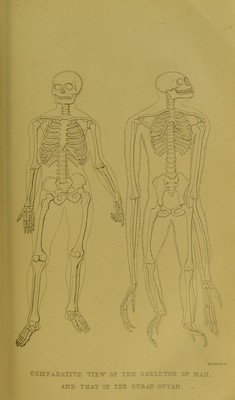
![81. The small size of the face of Man, compared with that of the cranium, is an indication that in him the senses are subordinate to the intelligence. Accordingly we find that while he is surpassed by many of the lower animals in acuteness of sensibility to light, sound, &c., he stands pre-eminent in the power of comparing and judging of his sensations, and of thence drawing conclusions as to their objective sources. Moreover, although none of his senses are very acute in his natural state, they are all moderately so; and they are capable of being wonderfully improved by practice, when circumstances strongly call for their exercise. This seems especially the case with the tactile sense, of which Man can make greater use than any other animal, in consequence of the entire freedom of his anterior extremities; although there are many which surpass him in their power of appreciating certain classes of tactile impressions.—So, again, Man's nervo-muscular power is inferior to that of most other animals of his size: the full-grown Orang, for example, surpasses him both in strength and agility; and the Gorilla, according to the statements of the Negroes who have encountered it, is more than a match for any single man, and is almost certain to destroy any human opponent once within his grasp.—The absence of any natural weapons of offence, and of direct means of defence, are remarkable characteristics of Man, and distinguish him not only from the lower Mammalia, but also from the most anthropoid Apes; in which it is obvious (both from their habits and general organization) that the enormous canines have no relation to a carnivorous regimen, but are instruments of warfare. On those animals to which Nature has denied weapons of attack, she has bestowed special means either of passive defence, of concealment, or of flight; in each of which Man is relatively deficient. Yet by the superiority of his reason he has been enabled not only to resist the attacks of other animals, but even to bring them into subjection to himself. His intellect can scarcely suggest the mechanism which his hands cannot frame; and he has de- vised and constructed arms more powerful than those which any creature wields, and defences so secure as to defy the assaults of all but his fellow-men. 32. Man is further remarkable for his extraordinary power of adapta- tion to varieties in external condition, which renders him to a great extent independent of them. He is capable of sustaining the highest as well as the lowest extremes of temperature and of atmospheric pressure. In the former of these particulars, he is strikingly contrasted with the anthropoid Apes; the Gorilla and Chimpanzee being restricted to the hottest parts of Africa, and the Orang Outan to the tropical portions of the Indian Archipelago; and neither of these animals being capable of living in temperate climates without the assistance of artificial heat, even with the aid of which they have not hitherto long survived their second dentition. So, again, although Man's diet seems naturally of a mixed minor which projects into each cornu, is peculiar to the genus Homo. How strangely inconsistent is this assertion with the well-known and certainly-ascertained facts of the case, has heen conclusively shown by Prof. Huxley in his Memoir ' On the Zoological Relations of Man with the Lower Animals,' in the Natural History Review,'] Jan. 1861, p. 71 et seq.; and the chief points of the controversy have since been succinctly stated in his Evidence as to Man's Place in Nature, 1863. For an excellent description of the Convolutions of the Human Cerebrum, see W. Turner, Ed. Med. Journ. June, 1866.](https://iiif.wellcomecollection.org/image/b24757007_0064.jp2/full/800%2C/0/default.jpg)

 No text description is available for this image
 No text description is available for this image
 No text description is available for this image