The electro-motive changes in heart-block / by G. A. Gibson.
- Gibson George Alexander, 1854-1913.
- Date:
- 1906
Licence: In copyright
Credit: The electro-motive changes in heart-block / by G. A. Gibson. Source: Wellcome Collection.
Provider: This material has been provided by the Royal College of Physicians of Edinburgh. The original may be consulted at the Royal College of Physicians of Edinburgh.
3/8
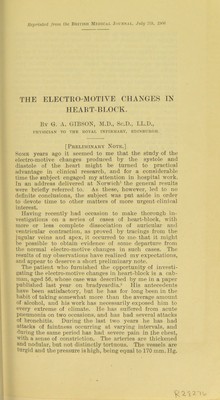
![Scprintcd from the British Medical Journal, July 7th, 1006 THE ELECTRO MOTIVE CHANGES IN HEART-BLOCK. By G. a. GIBSON, M.D., Sc.D., LL.D., physician to the EOYAL INFIBMARY, EDINBURGH. [Preliminary Note.] Some years ago it seemed to me that the study of the electro-motive changes produced by the systole and diastole of the heart might be turned to practical advantage in clinical research, and for a considerable time the subject engaged my attention in hospital work. In an address delivered at Norwich^ the general results were briefly referred to. As these, however, led to no definite conclusions, the subject was put aside in order to devote time to other matters of more urgent clinical interest. Having recently had occasion to make thorough in- vestigations on a series of cases of heart-block, with more or less complete dissociation of auricular and ventricular contraction, as proved by tracings from the jugular veins and apex, it occurred to mC' that it might be possible to obtain evidence of some departure from the normal electro-motive changes in such cases. The results of my observations have realized my expectations, and appear to desei-ve a short preliminary note. The patient who furnished the opportunity of investi- gating the electro-motive changes in heart-block is a cab- man, aged 56, whose case was described by me in a paper published last year on bradycardia.^ His antecedents have been satisfactory, but he has for long been in the habit of taking somewhat more than the average amount of alcohol, and his work has necessarily exposed him to every extreme of climate. He has suffered from acute pneumonia on two occasions, and has had several attacks of bronchitis. During the last two years he has had attacks of faintness occurring at varying intervals, and during the same period has had severe pain in the chest, with a sense of constriction. The arteries are thickened and nodular, but not distinctly tortuous. The vessels are turgid and the pressure is high, being equal to 170 mm. Hg.](https://iiif.wellcomecollection.org/image/b2172474x_0003.jp2/full/800%2C/0/default.jpg)