On the effect of electrical stimulation of the frog's heart, and its modification by heat, cold, and the action of drugs / by T. Lauder Brunton and Theodore Cash.
- Brunton, Thomas Lauder, Sir, 1844-1916.
- Date:
- 1883
Licence: Public Domain Mark
Credit: On the effect of electrical stimulation of the frog's heart, and its modification by heat, cold, and the action of drugs / by T. Lauder Brunton and Theodore Cash. Source: Wellcome Collection.
Provider: This material has been provided by The Royal College of Surgeons of England. The original may be consulted at The Royal College of Surgeons of England.
3/51
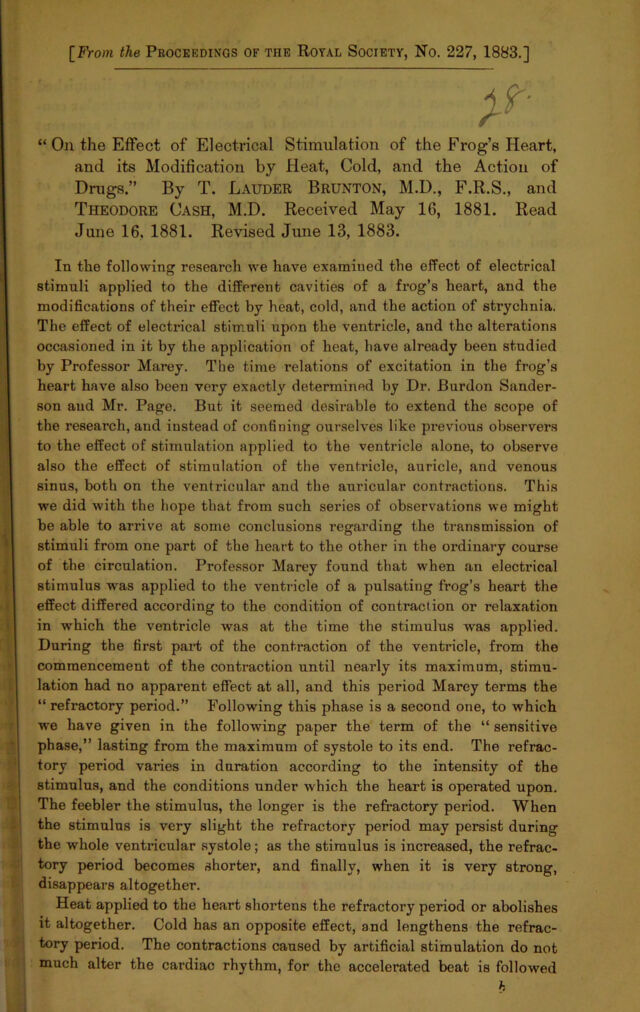
![[From the Proceedings of the Royal Society, No. 227, 1883.] “ On the Effect of Electrical Stimulation of the Frog’s Heart, and its Modification by Heat, Cold, and the Action of Drugs.” By T. Lauder Brunton, M.D., F.R.S., and Theodore Cash, M.D. Received May 16, 1881. Read June 16, 1881. Revised June 13, 1883. In the following research we have examined the effect of electrical stimuli applied to the different cavities of a frog’s heart, and the modifications of their effect by heat, cold, and the action of sti-ychnia. The effect of electrical stimuli upon the ventricle, and the alterations occasioned in it by the application of heat, have already been studied by Professor Marey. The time relations of excitation in the frog’s heart have also been very exactly determined by Dr. Burdon Sander- son and Mr. Page. But it seemed desirable to extend the scope of the research, and instead of confining ourselves like previous observers to the effect of stimulation applied to the ventricle alone, to observe also the effect of stimulation of the ventricle, auricle, and venous sinus, both on the ventricular and the auricular contractions. This we did with the hope that from such series of observations we might be able to arrive at some conclusions regarding the transmission of stimuli from one part of the heart to the other in the ordinary course of the circulation. Professor Marey found that when an electrical stimulus was applied to the ventricle of a pulsating frog’s heart the effect differed according to the condition of contraction or relaxation in which the ventricle was at the time the stimulus was applied. During the first part of the contraction of the ventricle, from the commencement of the contraction until nearly its maximum, stimu- lation had no apparent effect at all, and this period Marey terms the “ refractory period.” Following this phase is a second one, to which we have given in the following paper the term of the “ sensitive phase,” lasting from the maximum of systole to its end. The refrac- tory period varies in duration according to the intensity of the stimulus, and the conditions under which the heart is operated upon. The feebler the stimulus, the longer is the refractory period. When the stimulus is very slight the refractory period may persist during the whole ventricular systole; as the stimulus is increased, the refrac- tory period becomes shorter, and finally, when it is very strong, disappears altogether. Heat applied to the heart shortens the refractory period or abolishes it altogether. Cold has an opposite effect, and lengthens the refrac- tory period. The contractions caused by artificial stimulation do not much alter the cardiac rhythm, for the accelerated beat is followed](https://iiif.wellcomecollection.org/image/b22429931_0003.jp2/full/800%2C/0/default.jpg)