Report on ophthalmia in the metropolitan pauper schools / by Edward Nettleship.
- Edward Nettleship
- Date:
- 1875
Licence: Public Domain Mark
Credit: Report on ophthalmia in the metropolitan pauper schools / by Edward Nettleship. Source: Wellcome Collection.
Provider: This material has been provided by UCL Library Services. The original may be consulted at UCL (University College London)
11/122 page 9
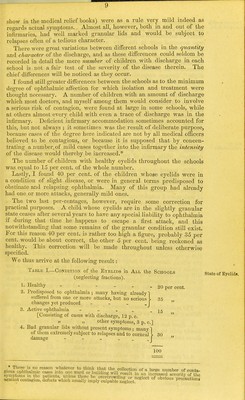
![show in the medical relief books) were as a rule very mild indeed as regards actual symptoms. Almost all, however, both in and out of the infirmaries, had well marked granular lids and would be subject to relapses often of a tedious character. There were great variations between different schools in the quantity and character of the discharge, and as these differences could seldom be recorded in detail the mere number of children with discharge in each school is not a fair test of the severity of the disease therein. The chief differences will be noticed as they occur. I found still greater differences between the schools as to the minimum degree of ophthalmic affection for which isolation and treatment were thought necessary. A number of children with an amount of discharge which most doctors, and myself among them would consider to involve a serious risk of contagion, were found at large in some schools, while at others almost every child with even a trace of discharge was in the infirmary. Deficient infirmary accommodation sometimes accounted for this, but not always ; it sometimes was the result of deliberate purpose, because cases of the degree here indicated are not by all medical officers believed to be contagious, or because it is supposed that by concen- trating a number, of mild cases together into the infirmary the intensity of the disease would thereby be increased.* The number of children with healthy eyelids throughout the schools was equal to 15 per cent, of the whole number. Lastly, I found 40 per cent, of the children whose eyelids were in a condition of slight disease, or were in general terms predisposed to obstinate and relapsing ophthalmia. Many of this group had already had one or more attacks, generally mild ones. The two last per-centages, however, require some correction for practical purposes. A child whose eyelids are in the slightly granular state ceases after several years to have any special liability to ophthalmia if during that time he happens to escape a first attack, and this notwithstanding that some remains of the granular condition still exist. For this reason 40 per cent, is rather too high a figure, probably 35 per cent, would be about correct, the other 5 per cent, being reckoned as healthy. This correction will be made throughout unless otherwise specified. We thus arrive at the following result: Table I.—Condition of the Eyelids in All the Schools State of Eyelids, (neglecting fractions). L Healthy 20 per cent 2. Predisposed to ophthalmia; many having already 1 suffered from one or more attacks, but no serious 1 35 changes yet produced _J 3. Active ophthalmia - _ _ _ - 15 [Consisting of cases with discharge, 12 p. c. » j) other symptoms, 3 p. c] 4. Bad granular lids without present symptoms; many] of them extremely subject to relapses and to corneal I 30 damage - - - _ j 100 * There is no reason whatever to think that the collection of a lanro number of rontn gious ophthalmic cases into one ward or buildinir will result, in ,, ; , , , J, \;? ? symptoms in the patients, unless Hi.™ bo ov rcrowuinK or negtecoT o^vfous n^antin against contagion, defects which usually imply culpable neglect obvious precautions](https://iiif.wellcomecollection.org/image/b21643295_0011.jp2/full/800%2C/0/default.jpg)