Diseases of the heart and arterial system : Designed to be a practical presentation of the subject for the use of students and practitioners of medicine.
- Babcock, Robert H. (Robert Hall), 1851-1930
- Date:
- 1910
Licence: Public Domain Mark
Credit: Diseases of the heart and arterial system : Designed to be a practical presentation of the subject for the use of students and practitioners of medicine. Source: Wellcome Collection.
Provider: This material has been provided by the Augustus C. Long Health Sciences Library at Columbia University and Columbia University Libraries/Information Services, through the Medical Heritage Library. The original may be consulted at the the Augustus C. Long Health Sciences Library at Columbia University and Columbia University.
34/888 page 10
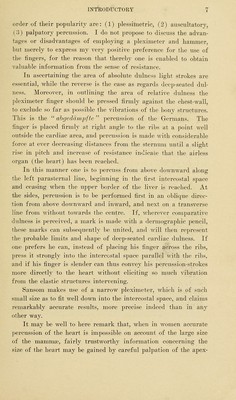
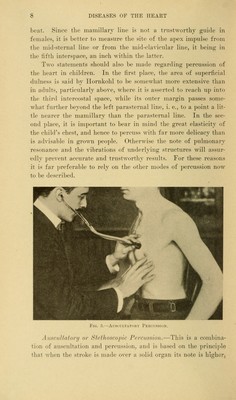
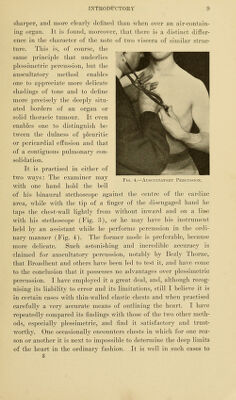
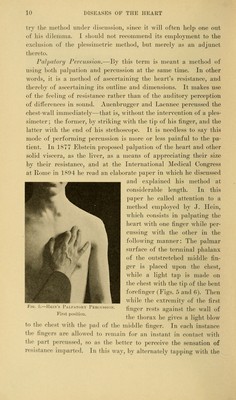
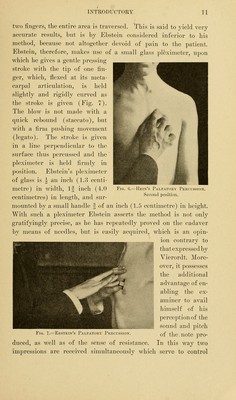
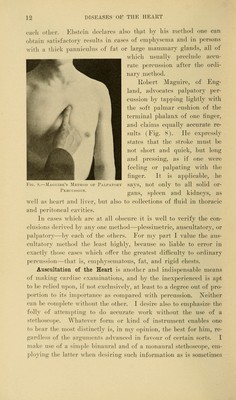
![try the method under discussion, since it will often help one out of his dilemnia. I should not recommend its employment to the exclusion of the plessimetric method, but merely as an adjunct thereto. Palpatory Percussion.—By this term is meant a method of using- both palpation and percussion at the same time. In other words, it is a method of ascertaining the heart's resistance, and thereby of ascertaining its outline and dimensions. It makes use of the feeling of resistance rather than of the auditory ])erception of ditl'ercnces in sound. Auenbruggcr and Lacnnec percussed the chest-wall immediately—that is, without the intervention of a ples- simeter; the former, by striking with the tip of his finger, and the latter w^ith the end of his stethoscope. It is needless to say this mode of performing ])ercussion is more or less painful to the pa- tient. In 1S77 Ebstein proposed pal})ation of the heart and other solid viscera, as the liver, as a means of appreciating their size by their resistance, and at the International Medical Congress at Rome in 1S94 he read an elaborate paper in which he discussed and explained his method at considerable length. In this paper he called attention to a method employed by J. Ilein, which consists in palpating the heart with one finger while per- cussing with the other in the following manner: The palmar surface of the terminal phalanx of the outstretched middle fin- ger is placed upon the chest, wliile a light tap is made on the chest with the tip of the bent forefinger (Figs. 5 and (!). Then wliilo the extremity of the first finger rests against the wall of the thorax ho gives a light blow to the chest with tlie pad of llic middle finger. In each instance the fingers are allowed to rcmaiii foe an iiistaiit in contact with the part percussed, so as the better to perceive the sensation of resistance imparted. In this way, by alternately tapping with the b'm. ;■).—IIein'h I'Ai.rATuUY I'kkci ssmN. First position.](https://iiif.wellcomecollection.org/image/b21229533_0034.jp2/full/800%2C/0/default.jpg)