Diseases of the heart and arterial system : Designed to be a practical presentation of the subject for the use of students and practitioners of medicine.
- Babcock, Robert H. (Robert Hall), 1851-1930
- Date:
- 1910
Licence: Public Domain Mark
Credit: Diseases of the heart and arterial system : Designed to be a practical presentation of the subject for the use of students and practitioners of medicine. Source: Wellcome Collection.
Provider: This material has been provided by the Augustus C. Long Health Sciences Library at Columbia University and Columbia University Libraries/Information Services, through the Medical Heritage Library. The original may be consulted at the the Augustus C. Long Health Sciences Library at Columbia University and Columbia University.
94/888 page 70
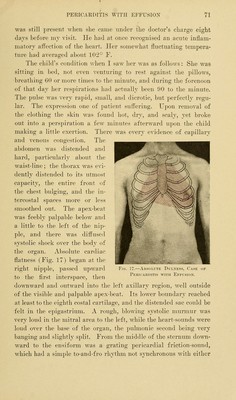
![body of the sternum pressure Avith the stethoscope brought out a soft rubbing murmur, which, from its quality and rhythm, was easily recognisable as pericardial. The inferior boundary of car- diac dulness was not dei)ressed; indeed the abdominal distention occasioned an eleyation of the heart. This high position of the liver caused the upper margin of hepatic dulness to reach the level of the fifth right costal cartilage and interfered with the detennination of the presence or absence of notch's sign. It seemed to me, however, that the outer border of the right auricle lacked its natural curve downward and inward, and that the line of dulness joined that of the liver at nearly a right angle. Tlie i)ain which change of position caused the little patient, rendered examination of the back of the chest inadvisable. The doctor stated, however, that the day before he had found dul- ness with corresponding alteration in the breath-sounds at the left posterior base. The diagnosis was acute rheumatic pericarditis with great cardiac dilatation and possible acute myocarditis supervening upon a previously existing endocarditis that had led to mitral in- sufficiency. Distinct signs of effusion were not obtainable, and hence it was conclud(>d that the exudate was fibrinous, or if united with serum, the proportion of the latter was not large. The ex- tensive dilatation present was attributed in part to the mitral lesion, and in part to the dilating influence of the pericarditis, Avhether associated with acute myocarditis or not. The symptoms in this case were not distinctly those of pres- sure; respiration was greatly accelerated, to be sure, but there was no cyanosis, no downward displacement of the liver, and no orthopncea; in short, the symjitoms pointed more to disturbance of the nervous system, with consequent rapidity of breathing, than to circulatory embarrassment. The very considerable hepatic en- gorgement could be very reasonably referred to the free mitral leak and the greatly overstrained right ventricle. This patient ultimately made a good recovery. On the same day on which I saw the preceding patient. Dr. Jo- sephson asked me to visit a little girl of six, who was also suffer- ing from acute pericarditis. She had ])assed through an attack of scarlatina in the Jnly preceding, and for the past three or four weeks had been suffering from acute articular rheumatism, which](https://iiif.wellcomecollection.org/image/b21229533_0094.jp2/full/800%2C/0/default.jpg)